

key con construction and design  dura-foam solar center  nil erdal realtor
Eichler Network CA Modern
ca modernmagazine cover
To Get
CA-Modern
Magazine
Click Here
los angeles conservancy
pixel
HOME | ABOUT | CONTACT | ADVERTISE
abril roofing


transparent pixel
eichler modern

Original Roster
of HTHB Builders

truck at building site

The following 20 builders participated in the 'House That Home Built' program, constructing from the same Jones and Emmons' plans. It's not clear how many of the HTHB homes each built, or exactly where they can be found.

East Coast:
Henry S. Schwier - Sea Girt, NJ;
John J. Farina - Newark, NJ;
Laducx Builders - Niagara Falls, NY; John Tilton - Rochelle, NY;
Frank P. Tufaro - Hartsdale, NY;
Nicholas Mauro - New Haven, CT

South:
C.B. Rogers, Jr. - Birmingham, AL

Middle West:
Robert P Gerholz - Flint, MI;
James Raisin - Pontiac, MI;
Bruce Blietz - Wilmette, IL;
Peter Krutschnitt - Cleveland, OH;
E.N. Cassinelli, Jr. - Cincinnati, OH

Great Plains:
Donald Drummond - Kansas City, KS; E.S. Johnson - San Antonio, TX; Marcus C. Bogue, Jr. - Denver, CO; N.D. Woods - Oklahoma City, OK

Pacific Coast:
Eichler Homes - Palo Alto, CA;
Pardee-Phillips - Fullerton, CA;
McCormick - Seattle, WA;
Robert Stanhorn - Portland, OR


This Intact HTHB Original
Has Stood the Test of Time

Like many owners of Don Drummond homes in Kansas City, Lisa Okazaki loves modern design. But, like many Drummond owners, she knows relatively little about the builder -- and even less about his Eichler connection.

The story of how Drummond built homes in Kansas City based on Eichler designs has been nearly forgotten -- or shrouded in myth. "I was under the impression that Drummond had gone to California, saw this style of house, and came back and tried to recreate it," Okazaki says. You hear this story from other owners -- or worse -- that Drummond had actually stolen plans from Eichler.

Okazaki had been living in her 'House That Home Built' home for two years before she learned it was an A. Quincy Jones design -- or that it had come about thanks to the Home TV show. Then an enthusiastic researcher showed up carrying the Jones and Emmons plan. Okazaki saw that her home matched the plan almost to the inch.

Her home was one of three based on the 'House that Home Built' plan constructed by Drummond in her south Kansas City, Missouri neighborhood. Approximately 17 others, including the model, were built in nearby Prairie Village and Overland Park, Kansas.

Unlike many Drummond homes, which have been irreparably altered, Okazaki's home is remarkably intact. Her Eichleresque kitchen is unaltered, though it lost its original appliances. Replacements have been tastefully fitted into the original sliding door cabinets. The kitchen retains its original island design with attached table. However, a built-in cook top was never installed in the island in Okazaki's house as per the Jones plan.

owner lisa okazaki

The living area, Okazaki's favorite space because of its openness to the kitchen, terrace, and all-purpose room, still has original cork floors. The one area that has been altered is the bedroom wing. The original metal casements were retrofitted years ago with poorly proportioned vinyl windows, and mahogany paneling has been covered by highly textured drywall, which Okazaki is replacing. Sliding-glass doors and wall openings that were filled in by a previous owner will be fitted with new glass.

Now that she knows the home's history, Okazaki is even more committed to preserving its original lines. "It makes me think twice about changing anything," she says. A self-confessed "architectural groupie," Okazaki spent six months looking for a Drummond home after architect friends recommended Drummonds. She chose the home "for the open floor plan and the indoor-outdoor living," not knowing its architectural provenance.

Okazaki is furnishing the home with period pieces, including a black George Nelson slat bench and an Eames table. "I am on a quest for a Saarinen tulip table," she says.

Drummond owners are faced with challenges -- crumbling ductwork and high humidity caused by cardboard ducts buried under concrete, antiquated wiring, and the difficulty of finding historically appropriate materials and skilled craftspeople. But all that pales compared with the pleasures of living in her timber-and-glass home, Okazaki says.

"I love the clerestory windows," she says of the home. "The light that comes in to this house is amazing. I don't feel like I am living in a dungeon."


pixel

THE HOUSE THAT 'HOME' BUILT
When national TV put Eichler Homes
at center stage with the ambitious
"House that 'Home' Built" program

From the pages of the
Eichler Network newsletter
By Robert McLaughlin

Eichler homes are as much a part of the California landscape as chaparral and live oak trees. Except for a handful of Eichlers in upstate New York, and the enclaves of look-alikes found mostly on the West Coast, Eichler homes never made much impact on the country as a whole. But for a brief time in the mid-1950s, it looked like they might.
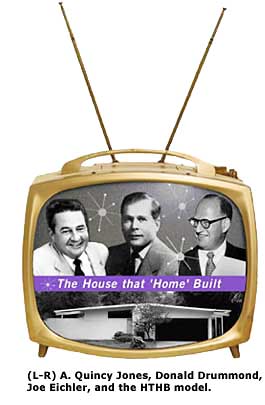
a. quincy jone, drummond, joe eichler in tv

In 1955, thanks to the then-popular NBC television show Home, a design that architectural firm Jones and Emmons originally created for Eichler began popping up in 20 or more cities throughout the United States. Each was built by local merchant builders attracted to the program by the free publicity provided by the popular show, sort of a 1950s version of HGTV. One builder who enthusiastically embraced the program was Donald Drummond, the nearest thing the greater Kansas City area had to a Joe Eichler.

Hosted by actress and entertainment personality Arlene Francis and correspondent Hugh Downs, Home aired weekdays following NBC's Today show. It had two million viewers, mostly women. Its 'House That Home Built' segment, which ran regularly, tried to persuade America that glass-walled, low-gabled, modern homes would work anywhere in the country, not just sunny California.

The 'House That Home Built' was co-sponsored by NBC and the National Association of Home Builders. Housing expertise was supplied by C.W. Smith, director of the Southwest Research Institute's Housing Research Foundation. "We recognize that regional preferences exist," Smith told 'House and Home' magazine in an April 1955 story, "but we want to show people that steep roofs, small windows, and basements in the northeastern part of the country are due entirely to prejudice and habit and are entirely unnecessary technically as well as undesirable from a performance standpoint." Each builder paid $200 for the plans and agreed to build one model to be open to the public. A June 4 deadline was set to coincide with Home's national publicity.
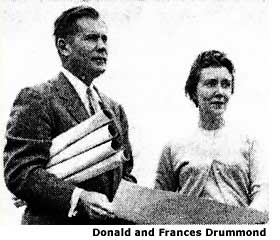
donald and frances drummond

The program was likely the brainchild of Eichler, who hoped the buzz generated by the show would promote his houses. According to an article in that April issue of 'House and Home,' Eichler and Smith persuaded A. Quincy Jones and Frederick Emmons to design the house. The producers' mandate to Jones and Emmons was to design a house appropriate for any climate that could be constructed by builders anywhere in the United States. The program's goal was to show "that an attractive, up-to-date house, embodying principles of good design, can be built at a moderate cost."

Promotion began when a model of Jones and Emmons' design appeared on Home, which was broadcast from New York, on February 28, 1955. Jones realized that what worked for buyers in California might face resistance elsewhere. "We are going to be criticized that it is extreme, but it's not," he said. "Almost everything that's in here we've been doing for ten years." Eichler appeared on the show with Illinois builder Bruce Blietz two days later, and Drummond appeared March 25. Commercial television was only a few years old, but both builders understood its power. "I figured I had about five minutes to sell a thousand houses," Drummond recalled in a recent interview.

'The House that Home Built' was a typical Jones H-plan, with two terraces bordered on three sides by exterior walls. Kansas City Drummond owners call them 'side atriums.' One terrace is adjacent to the public entrance. The other is a private outdoor living area. An open kitchen-living area forms the center of the house, connecting the two legs of the H. Bedrooms fill the rear leg, while a carport and all-purpose room fill the front leg, which faces the street. The bi-nuclear plan successfully separates living and sleeping areas.

The roots of the home reach back to as early as 1951 and Jones and Emmons' plan JE-35 for Palo Alto's Channing Park. By 1955, the architects' designs for models JE-15 (built at Palo Alto's Greenmeadow), MC-55 (Terra Linda), JE-85 (Sacramento), and SM-133 (San Mateo Highlands) all closely resembled the final HTHB design.
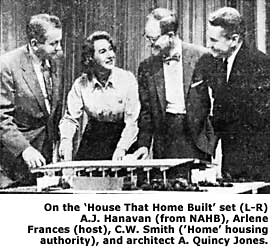
on the set of HTHB

A version of the JE-85 appeared in 'House and Home' in July 1955, and seemed to be the immediate predecessor to the 'House That Home Built' model. Photographer Ernie Braun's photos for the article were dated April 1955, taken less than a month after Eichler's appearance on the NBC program. Jones and Emmons had designed more than 200 plans for Eichler by 1955, according to House and Home at the time, and the 'House That Home Built' seemed to be the pinnacle of this particular plan type. Soon Eichler's focus would shift to plans around courtyards and atriums.

Unlike earlier Eichlers, the post-and-beam frame and fascia of the 'House That Home Built' extended past the roof eaves to form a trellis-like-overhead structure on the side terraces. Two things Jones thought unusual were the location of the laundry between bedrooms, and a built-in dining table with two built-in burners and an oven at the end. Jones had recently designed a similar prototype kitchen for Frigidaire. A table cook top was also included in Jones' own steel house built for his family in 1954 in Southern California and the X-100 steel prototype of the San Mateo Highlands that he designed for Eichler a year later.

The most notable refinement to the new plan was a sliding-glass door between the kitchen and terrace. "This blew the whole center of the house open," says Scott Lane, a Kansas City real estate broker and a former owner of two Drummond homes. Other changes included the substitution of a carport for a garage and revised bathroom locations.

kansas atrium model home today

Eichler and Drummond were masters of merchandising. It is no coincidence that the kitchen, baths, and laundry were the focus of changes to the plan. This reflects the power women were gaining over such major decisions as buying a house. Not relying solely on NBC's Home to reach would-be buyers, Drummond had a local cooking show broadcast from the kitchen of his model home. The show promoted appliances that could be purchased with the home. "There was a nice little profit to be made from the sale of these appliances with the house," Drummond says.

Some of the builders who took on the 'House That Home Built' challenge may have been nervous about the home's modern touches, but not Drummond. Unlike most of the builders, who constructed only one home, Drummond was soon-building several. Drummond was unsure about one aspect of the house -- the master bedroom's sliding-glass door. But he was overruled by his wife and partner, Frances (who was responsible for-her husband's career-making decision to hire a real architect to design his homes). "Francie thought it was a good idea, so we kept it," says Drummond. "She thought it would appeal to the women."

Cleveland builder Peter Krutschnitt modified the plan, probably to deal with harsh winters. As seen in a 1955 advertisement for Fenestra Windows, the house was rotated so its side entry now faced the street, something Drummond did as well. The carport was replaced by a garage, and the roof overhangs were extended to provide protection for rafter ends.

By late spring the publicity for the homes was beginning to peak. The June 1 episode of Home featured a segment showing Thomas Church, one of the founders of modern landscape architecture, preparing designs for Eichler. And across the country, builders were hustling. "My father had workmen working day and night the last two weeks of the project," says Henry Schwier, Jr., the son of New Jersey builder Henry Schwier.

On June 3, the day before the homes' public opening, the entire show was devoted to the 'House That Home Built,' beginning with a race among movers in San Francisco, Chicago, Kansas City, and Denver to outfit the homes with model furnishings. Afterwards, each builder was interviewed.

Not every builder, however, crossed the finish line on June 4. Some builders blamed the delays on a late spring. Others had trouble getting FHA approval for loans. Eichler and Drummond finished their houses on time along with at least seven other participants. At least 11 builders were given a second deadline, September 10, during National Home Week. All of the latecomers who finished for this deadline were from northern states.

plans

Most of the builders did well thanks to the program. "Eleven sales consummated, $242,000 volume," Drummond telegraphed Home in late June. "Thirty sales in process of being signed, at $720,000. Three weeks after Home promotion, sales response becoming stronger daily. Public thinks house is wonderful. It is affecting the desire to buy... Combined promotional effort is now snowballing. Market appears unlimited here. Will appreciate the opportunity to cooperate with Home in any way."

Eichler Homes had similar news to report. "Sixteen houses sold in four locations," read a telegram from Eichler Homes' staffer D.L. Stoffe. "Total of 61 various houses sold within the four developments [most likely those at Terra Linda, Sacramento, San Mateo, and either Palo Alto or Walnut Creek]. Attendance in first 12 days approximately 10,000. Public response excellent. Sizable coverage of story in all San Francisco newspapers and many others in Northern California."

1955 Terra Linda Eichler home (model MC-55)

As it turned out, the 'House That Home Built' was unable to ignite a nationwide desire to live in Eichler-style homes. By October 1955, Home was planning new programming for 1956 with New York architect Eldridge Snyder designing three conservative, split-level ranch alternatives. Neither Drummond nor Eichler would participate in this second program.

By the late '50s, romantic styles trickled into shelter magazines, crowding out the modern. For some builders, Home was their first and only foray into modern design. For Drummond, however, the program was just one step in a career largely devoted to modern home construction.

Today, although the 'Drummonds' have not achieved the mythical status of Eichler homes, they have a dedicated, cult-like following of owners -- many artists, designers, architects, and realtors among them -- who appreciate their open plans, post-and-beam structure, and expansive glass.


Builder of 1,100 Kansas City Homes,
Donald Drummond Had an Eye for Modern

Drummond then

Donald Drummond was a remarkable individual who pioneered modern residential architecture in Kansas City, Missouri. He was a part of a small group of merchant builders in the United States who succeeded in building post-and-beam, glass-walled tract homes.

Also remarkable are the parallels between Drummond and Joe Eichler. Both promoted the virtues of modern indoor-outdoor living -- virtues that played better in the cultural and natural climate of California. While Eichler was building 11,000 homes in California, Drummond was building as many as 1,100 homes in the smaller, more conservative Kansas City market. Drummond's operation, which lasted from 1946 to 1964, was of average size for a central states merchant builder. Eichler cited time spent living in a Frank Lloyd Wright house in Hillsborough as having shaped his sensibilities. For Drummond, it was an education in engineering that informed his work.

According to Kansas City real estate broker Scott Lane, Drummond and Eichler were targeting the same market. "These homes were built for the sports car-driving, pipe-smoking, wine-drinking enthusiast," he says. "These homes were for the owner who read New Yorker magazine and had a refined appreciation for modern living."

Born in Chicago in 1915, Donald H. Drummond moved to California at age three. He grew up in La Jolla, "knowing at age six that one day I wanted to be a builder." After attending California Institute of Technology, and Stan-ford University, where he graduated with a mechanical engineering degree in 1937, he began working for Henry John Kaiser, building Shasta Dam.

Drummond met his future wife, Frances Woodruff, at Stanford. After marrying in the early 1940s, he worked as chief engineer for Harland Bartholomew and Associates, overseeing construction of more than 20,000 units of defense worker housing, mostly in Virginia.

Drummond today

After World War II and three years with the Seabees, the construction battalion of the Navy, Drummond moved to the Kansas City area. In 1946, just before Eichler, Drummond and Francie began building homes. Drummond's first self-designed homes did not use a contemporary vocabulary. "They were just boxes," he says. "They were more of an engineer's house. They were logical, but not beautiful."

Drummond also built flat-roofed designs known today as 'flatties.' These came from successful Bay Area builder Earl 'Flat Top' Smith. "I was interested in them because of the framing," he says. "Being an engineer, I liked-a beautiful structure." Eichler also built from Smith's plans-before hiring Anshen+Allen, his first architectural team, in 1949.

Unhappy with these early designs, Frances Drummond insisted they hire an architect. "I had a smart wife," Drummond brags. Starting in 1949 Drummond's projects were designed by Kansas City architect David B. Runnells. Runnells had attended the Cranbrook Academy of Art in Michigan, and worked for architect Eliel Saarinen, a patriarch of American modernism. The homes were 900-square-foot modern Cape Cods. Runnells used a post-and-beam construction that would become a Drummond trademark.

Runnells designed another plan for Drummond in 1949 that was honored as part of the Revere Quality Homes Program, intended to advance "better architect-builder relations and the general improvement of the quality of speculatively built houses." In 1952 Eichler would receive the same honor. In 1950, Drummond's Revere house was published in 'Architectural Forum' and 'Life' magazines. Eichler's first architect-designed house also appeared in both articles.

Drummond's most popular plan, however, was his most conservative, the 'Home for 52 and You.' From the street, the '52' resembled a contemporary ranch, with a front façade of board-and-batten siding of pecky cypress. The rear and interior were more explicitly modern. The signature vaulted post-and-beam ceiling was there, as well as surprising expanses of glass opening onto-a backyard living area.

castilian model

In 1954, Drummond participated in the U.S. Gypsum Research Village project in Barrington, Illinois. He teamed with St. Louis arch-itect Harris Armstrong. Also participating were A. Quincy Jones and Eichler, who collaborated with another builder on site to erect a steel house that predated their X-100 project. Drummond and Armstrong's house was a conventionally framed wood-and-brick structure. It was a simple rectangle with a gabled front, enlivened with an attached carport, trellises, and garden walls that created outdoor rooms. The concept was to enlarge the plan by making the interior rooms extend into the outdoor spaces.

In 1955, during the 'House That Home Built' period, the Drummonds visited Eichler and toured several of his subdivisions. "We called on him because he was a volume builder, he had some good techniques, and he was a nice person," Drummond said. "We saw his plans and he told us who he had working for him. We called (Jones) and he went to work for me." The resulting plan was the 'Castilian,' the biggest and most lavish plan that Drummond would build.

The 1956 Castilian was a quintessential Jones and Emmons H-plan, with terraces facing front and back. This addressed the criticisms that earlier Eichler H-designs had unceremonious entrances. The Castilian proudly turned its broad gable and its larger fenced entry terrace to the street, foreshadowing the Eichler atriums.

Drummond built modern homes until 1964 when, during a housing downturn, he moved to California. He and Francie went on to build a few traditional houses in Pebble Beach and the surrounding area, and then began traveling Central America in search of orchids.

Don and Francie Drummond now live in Carmel, where they have been growing orchids commercially in their ten greenhouses.


Photos courtesy Robert McLaughlin, Ernie Braun, A. Quincy Jones Architecture Archive.


See other Eichler Modern Stories


dura-foam solar center
eichler solutions

Top of Page

pixel

The Eichler Network
info@eichlernetwork.com