

|
Introduction:
Eichler's Wrightian Experience
By Paul Adamson
A great admirer of architect Frank Lloyd Wright, Joseph Eichler had moved his
family to California from New York in 1940, and three years later had the rare
opportunity to rent a Usonian House Wright designed for Sidney and Louise
Bazett, in Hillsborough, just south of San Francisco. Although consisting of
only a living/dining room and three small ship's cabin-like bedrooms, including
the guest house, the Bazett residence accommo- dated Eichler and his family,
sometimes as many as seven people at a time, from 1943 until 1945, when the
house was sold to Louis and Betty Frank.
Eichler's experience living in the Bazett house was profound, and inspired a
change in his life. He had been the treasurer for the family produce business,
but was forced to change careers when the company encountered difficulties
during the war. Inspired by Wright's use of natural materials and his masterful
manipulation of daylight, he later remarked that the Bazett house introduced him
to "an entirely new way of living." Living there, he wrote, "was such a
wonderful experience," that he determined to go into the house-building business
himself with the idea of producing "contemporary houses for sale to the person
of average income."
On the scale of the individual family, Wright imagined the Usonian: a warm,
open-planned, small home designed for convenience, economy, and comfort.
Wright's model of residential design for the "everyman" would provide abundant
lessons for the designers of Eichler Homes. While the formal imagery of the
Eichlers more closely resembles European Modernism, their integration with the
landscape and the specific use of indigenous materials owes a debt to Wright,
who pursued his vision of the well-designed small house with a sense of moral
purpose.
Unlike the mass- produced Eichlers, Wright's Usonians were always custom
designed for individual clients, but the homes were always very modestly scaled;
their planning made efficient with built-in furniture and a minimum of
circulation space. The architects who designed Eichler's homes would employ many
of Wright's Usonian principles when designing Eichler's prototypes.
Many features of Wright's Usonian houses, including the Bazett house, and the
more famous Hanna house constructed in Palo Alto in 1938, are common to the
Eichler homes. It would seem likely, considering their proximity and their
considerable notoriety, that these homes provided Eichler's first architect, Bob
Anshen, who felt such deep sympathy toward Wright's work, convenient resources
for ideas and techniques. In fact, the design parameters Wright defined for his
Usonians were remarkably similar to those Anshen would employ in his
prototypical designs for Eichler.
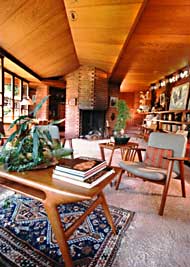
When seen today, the Bazett house is obviously a product of an earlier time.
The fact that nothing about the house is standardized points to a condition,
before modern codes and the machine-like construction methods of contemporary
building, when houses were "hand crafted." Ornament aside, however, it is the
careful accommodation of the intimate duties and pleasures of domestic life that
have made this Usonian meaningful for the Franks for almost 55 years. And for
Joe Eichler and Bob Anshen, the house was a touchstone that never ceased to
resonate for either of them as they strove to transcend the limits of merchant
building.
|
THE BAZETT HOUSE
A 'paradise lost' that Joe Eichler never regained
-- the legendary Bazett house of Frank Lloyd Wright
From the pages of the Eichler Network newsletter
By Marty Arbunich
If an Eichler hall of fame ever
has its day, Betty and Louis Frank will be prime candidates for induction. Until
then, they'll at least have our collective appreciation for their role in
passing builder Joseph Eichler through the turnstile of golden opportunity.
It was the Franks who pointed Eichler in a new direction in the
postwar - away from life in the Frank Lloyd Wright-designed Bazett
house, and towards recreating the essence of the Bazett experience for
himself and others many times over by building 11,000 homes.
If the young Franks had not taken over the pivotal Bazett of
Hillsborough back in 1945, serving Eichler, their inherited tenant, with
90-day eviction, history might have followed a very different course.
Rather than launching a new career in residential building, Eichler
might have stayed put in the Wright Usonian he treasured, eventually
slipping into complacency on his way to the top rung of his family's
butter-and-egg business - never having to long for paradise lost.
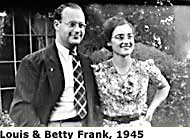
Nearly 55 years have passed since that transition, and Betty Frank is as
thrilled today about living in and owning the Bazett house as she was on that
first day. "I never could have imagined myself living in such a work of art,"
she told us recently, her excitement still strong."But this house has always
been so perfect for me and my family. It's
uplifting, practical, and it moves so beautifully."
Even a perfect fit like the Bazett has its loose ends. Between her
praises of a home and lifestyle that she continues to adore, Betty
returns her focus to the mystery surrounding her home, and to questions
about its original owners that have haunted her for much of the past
five decades. As fate would have it, the Franks, in spite of occasional
attempts to contact the Bazett family during their first 30 years in
Hillsborough, never met Sidney and Louise Bazett, the previous owners.
But throughout the years, the Franks continued to wonder about the
whereabouts of the Bazetts, and always wanted to know why, only two
short years after building their dream house, the couple walked away
from it all. "Every so often I read the correspondence between the
Bazetts and Mr. Wright from 1940," Betty said. "They were so excited
about the house as it was being built. Everything seemed wonderful, and
they were even expecting the stork in May of that year. Then there was a
total turnaround, as if something very traumatic had happened. Before
long, Mr. Eichler is renting the house - and we hear nothing ever again
about the future of Mrs. Bazett."
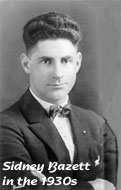
The first chapter of the Bazett house story opened in 1938, seven
years before the arrival of the Franks. It began with another young
couple - Sidney Bazett-Jones, an ambitious businessman based in San
Francisco who, in his late 30s, had reached the prestigious position of
vice president of Bank of America; and his wife of four years, the
former Louise Reno, from a well-known San Mateo family.
The war was on in Europe, but its specter did not discourage the
Bazetts from approaching architect Frank LloydWright to design their
dream home, albeit of modest proportions, on their own undeveloped
property in Hillsborough. Its plan would follow some of the same design
features, including the use of hexagonal, honeycomb-like modules, he
brought to the Hanna house, his first Usonian in California, built two
years earlier on Stanford University.
The planning and negotiations between the Bazetts and Wright, who
was at Taliesen, in Spring Green, Wisconsin, was conducted primarily
through the mail, and much of that correspondence has survived the
years. With well-defined requirements for design, a budget of $7,000,
and a seemingly keen appreciation of fine architecture, the couple
commissioned the architect in April 1939. "With even our meager artistic
knowledge," Sidney Bazett said humbly in that letter to Wright, "it was
apparent that it would be a shame to have anyone other than Frank Lloyd
Wright design our home."
Jean Hanna, who with husband Paul owned the Hanna house, extended
the Bazetts a hand during early planning. While Sidney seemed to find
her detailing tedious, the Bazetts agreed with her suggestion to draw up
exhaustive lists of design requirements for each of the interior rooms
and outside areas, personality traits, and hobbies. Among them were
requests for single-story construction, a master bedroom (of three
bedrooms in all) that opened onto a porch, no separate dining room, easy
access to the outdoors, and a two-car shelter. Opening a small window to
their personas, Sidney saw himself as "restless, except when outdoors,"
with "an excessive amount of energy"; Louise preferred architecture that
exuded a "feeling of permanence."
The Bazetts appeared disappointed with several of the preliminary
sketches that arrived in May, but remained optimistic. "There is no
question that the plans possess beauty and charm," wrote Sidney to Mr.
Wright's secretary, Eugene Masselink, "but we do feel that the plan
proposed is not suited to the property, climate, our requirements, and
our pocketbook." In particular, he cited the positioning of the driveway
and the selection of a pitched, 'Tahoe-type' roof. "We are in a warm
California climate," he reminded his architect, requesting a horizontal
roof line close to the ground. Ever the businessman, Bazett kindly
withheld the expected three percent deposit, and asked that Wright
personally visit the site.
Wright responded quickly, agreeing wholeheartedly with his clients.
"I've returned from Paris and Dubrovnik, and see how a good idea can
miscarry in my absence," he wrote, seeming surprised with his firm's
performance. "You are right about the unsuitability of the house."
Returning two weeks later with revamped designs, Wright felt compelled
to show his own excitement. "Here is the result," he wrote. "I like it
more than a little...A fresh design for living...Ideal for your
climate." The Bazetts chimed in. "It is perfect, and we are in love with
the house already,' they responded excitedly. The excitement likely
mounted a month later when the couple received news that Louise was
pregnant.
Having agreed on a design, Bazett turned his concerns to the final
working plans, scheduling, and the management of building costs. Fearful
of the rainy season ahead, he pushed to commence construction in August
1939, but delays persisted. The drawings arrived in September, at which
time Bazett hired Oscar Cavanagh, a builder based in San Mateo. Bazett
agreed with Wright's suggestion to hire an architect's assistant from
his fellowship to supervise construction, thus "not only saving our
clients cost of the general contractor fee but get the results of which
we can be proud of."
In spite of his good intentions, when Wright revised the cost
projections in October, the figure had climbed to as much as $12,000,
leaving Bazett scrambling to cut back. As Blaine Drake, Wright's
assistant, arrived in February, costs had risen an additional $750, and
Bazett looked to his architect for relief. "All of this is placing a
much heavier burden on me than I had anticipated," he wrote, asking
Wright to find an opening to shave expenses.
By the time construction began in March 1940, the Bazetts had rented
a larger house, in San Mateo, only four minutes from the construction
site, to accommodate Drake and be close at hand as their new home
unfolded. Drake proved to be a most capable supervisor, easing the
concerns of the Bazetts and moving construction along quickly. He
reported faithfully to Wright, mailing weekly letters and payments, and
even expressing his growing fondness for his clients.
|
"Mr. Bazett...sees the completion of a contract more important than
the beauty a few more dollars would bring to the house," Drake wrote to
Wright early in the construction. But later, he saw his client in a
different light when he reported, "Mr. Bazett finally realized that up
to now he has had more confidence in [general contractor] Cavanagh than
in his architect. And now, realizing you were working for his ultimate
good, he endorses the fulfillment of your design."
The price of fulfillment, however, was almost twice the original
budget at the close of construction in June. Even though financial
bickering lingered, the Bazetts, and in particular Louise, seemed
thoroughly happy with the results. "We truly have more of a home than we
had ever hoped for," she told Wright. However, all was not joyful. As
their new home was about to come to life, their baby arrived stillborn.
And six months later the U.S. had entered the war.
Betty and Louis Frank knew none of this history when, as the war
came to a close, they bought the Bazett house in April 1945. For the
previous three years, the Franks had been living in a tiny duplex in the
San Mateo lowlands, but Betty's respiratory condition, aggravated by
winds, forced the couple to look to the sheltered hills for relief.
The Franks had been looking for a home in Belmont and San Carlos for
more than a year when their realtor drove them to Hillsborough, and to
the Bazett house, which had been on the market for almost a year. In
Sidney Bazett's absence, the house had been rented to Joe Eichler and
his family since early 1943. Eichler was absolutely in love with the
house, which had introduced him to a new and engaging way of life, but
his family's troubled butter-and-egg business and a trying relationship
with Mr. Bazett stood in the way of his own purchase.
Nonetheless, Eichler didn't want to give up the house, and as Betty
Frank recalled, became uncooperative. "Our realtor told us the Eichlers
had been sabotaging things, and wouldn't let anyone show the house,"
Betty recalled. "But when we drove up to the house, lo and behold, Mrs.
Eichler was outside rummaging through some things and couldn't escape
us."
Even though Betty knew little of
Wright's accomplishments, she instantly fell in love with his design. "I went
absolutely berserk over it," she admitted. "The house had everything I wanted -
beauty, a big garden, and it was sheltered."
Shortly afterwards, the Franks completed the sale. Despite Joe
Eichler's intimation that he would only move out feet first if any sale
went through, the Franks gave the Eichlers 90-days' notice and hoped for
the best. Three months later, the Franks were relieved when Eichler
reluctantly gave up his hold, and moved his entire family to the
Beresford Country Club in San Mateo.
Four years later, after gaining a foothold in merchant building,
Eichler returned to the Bazett, and brought with him an entourage of
business associates to tour the house which had inspired his career. The
Franks were not at home, but Betty's mother let them in. When Eichler
stepped inside, the memories of his 'paradise lost' seemed to overtake
him. "My mother told me there were even tears running down Mr. Eichler's
face," Betty remembered. "The man was obviously very touched coming
back."
A part of the Bazett house mystery remains unsolved - neither Louise
nor her family have been located - but Betty Frank recently put together
other pieces of the puzzle with the help of Sidney Bazett's children
from a later marriage. Following the completion of the Bazett house in
1940, Sidney and Louise separated. Over the next two years, Sidney
changed his life dramatically, as he would do often during his life. He
quickly moved from Bank of America to the presidency of a San Francisco
securities firm, and then on to Florida, where he held a Lt. Colonel's
rank in the U.S. Army Air Corp until war's end.
Always eager for a challenge, and perhaps as restless as he claimed
in his 1939 correspondence to Wright, Bazett married six times during
his 81 years and held countless distinguished career positions, even as
a politician and Oregon state representative, until his death in 1983.
Not unlike Eichler, Sidney Bazett found a way to cope with the
hidden costs of building a house in the spirit of the Bazett, and
continued to draw from the home as a source of inspiration. In 1954, he
commissioned an architect to design a modern-styled house, in Grant's
Pass, Oregon, similar in many ways to the Hillsborough home he left
behind. And to his children, he passed on a deep appreciation for
quality design, and just enough family history to encourage them to
finally meet Betty Frank and the Bazett house face to face for the very
first time.
Wright and Bazett house construction photos and Wright letters ©
copyright 1999 Frank Lloyd Wright Foundation, Scottsdale, AZ
Betty Frank today photo: Doug Baird
Bazett house today photo: Robert Skolmen
Sidney Bazett photo and letters courtesy Bazett family
See other Eichler Modern Stories
|