

ronkey_1A  dura-foam solar center  nil erdal realtor
Eichler Network CA Modern
ca modernmagazine cover
To Get
CA-Modern
Magazine
Click Here
mod walls sign up for prizes
pixel
HOME | ABOUT | CONTACT | ADVERTISE
abril roofing
Loni Nagwani realtor
advertise here

transparent pixel
eichler modern

THE MYSTERY OF THE EICHLER ATRIUM
An inside look at the 'hole in the house' sheds
light on when and how the Eichler atrium was born

From the pages of the
Eichler Network newsletter
By By David Weinstein

atrium view

There should be nothing mysterious about the origin of the Eichler atrium. The atrium, a design milestone, became the Eichler homes' most popular feature. For some people, it became the defining feature.

The atrium's birth is not the sort of thing you'd forget. In fact, two men who were there in the 1950s when the atrium concept unfolded remember the event well. But, as their stories go, each recalls the birth of the Eichler atrium happening at a different place and time.

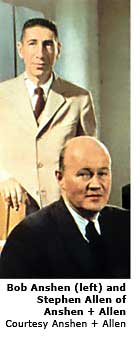
According to Ned Eichler, Joe Eichler's son, the idea popped into architect Bob Anshen's head and onto his drawing board during a 1957 meeting attended by Joe and Ned. According to August Strotz, then a draftsman with Anshen + Allen, the first of three architectural firms to design the Eichlers, the idea arose during a brainstorming session among several architects. Both credit Anshen, however, with the concept and the name.
anshen and allen

But the mystery goes beyond which meeting saw the first mention of an 'atrium.' Homes designed and built even before the term was adopted by Eichler clearly contained what soon was dubbed an atrium. Questions also remain about the definition of an atrium.

Is an atrium different from a courtyard? How? Did it evolve from earlier Eichler courtyards or spring to life all on its own? Were there any 'atriums' before 1957 or 1958, when Eichler Homes first used the term for marketing purposes? And, finally, is an Eichler atrium really an atrium?

Many observers, including longtime Eichler saleswoman Catherine Munson, note that the atrium goes back at least to ancient Greece. "We should never use the word 'invented,'" she says. "Eichler Homes never invented atriums at all."

The Eichler atrium, in fact, was less an invention than a decision; and the decision, of course, was Joe Eichler's. And despite all the talk of its invention in 1957 and construction in 1958, studying the plans makes it clear that Eichler Homes was building something very much like an atrium almost from the firm's beginning, back in the early 1950s.

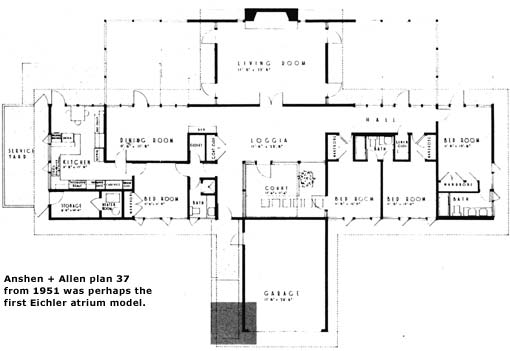
Eichler's plan 37, from August 1951, a full six years before Eichler Homes used the term 'atrium,' shows a 'court' that counts as an atrium under almost any definition -- an outdoor area, open to the sky, and entirely surrounded by house (if you count the garage as 'house'). Designed by Anshen + Allen, one model of plan 37 was built in Atherton's upscale (and ultimately unsuccessful and unfinished) Lindenwood development. Marketed for the then-high price, for an Eichler, of $47,500, the 37 has an 11-foot-square 'court' surrounded on one side by a bedroom, on another by a loggia that opens onto the rear living room, on a third by a garage, and on the fourth by an interior entry hall.

And in 1956, one home based on Anshen + Allen's E-5 'court' plan built in the San Mateo Highlands also fits the Eichler definition of an 'atrium' -- a courtyard surrounded by living space and an enclosed carport, entered through the carport. This was a full year before the word 'atrium' appeared on an Eichler plan. That lone E-5 in the Highlands was an original Eichler Homes model home, and versions of it may have been built in other developments. The E-8 plan, another Anshen + Allen model from 1956, has a similar surrounded courtyard. It's not clear, though, whether this model was ever built.

Beyond the Eichlers:
Roots of the Atrium

atrium view

Historians say houses built around atriums were constructed by the Etruscans in 700 B.C. In the center of the atrium were cisterns to catch rainwater. Greeks were also building homes around arcaded courts called 'peristyles.' The Roman atrium house, whose remains can be examined in Pompeii, combined both these features. Roman atriums brought in light and air, and were often filled with gardens.

Atrium houses can be found throughout medieval Europe and North Africa. Spanish manor houses were built around courtyards for safety and aesthetics. Many Moorish buildings in Spain and Africa featured atriums, including the Alhambra. Medieval Jewish quarters in Southern Europe were often a warren of homes built around inner courtyards where most family life took place.

August Strotz, an architect who worked at Anshen + Allen during Eichler's development of the atrium, has a familial relationship with the form. The Palazzo Strozzi, a famous 15th century palace in Florence with a four-story atrium, was built by his ancestors, the Strozzi family.

The atrium appeared in Spanish colonies across the globe. Havana remains a city of 'patio houses.' In California, Spanish Colonial architecture focused more on courtyards than atriums, probably because these were rural sites, not urban.

In modern days, some of the architects who created Santa Barbara's neo-Spanish Colonial look in the 1920s, including George Washington Smith and Mary Craig, designed atrium homes. Many houses in San Francisco's Sunset District, including storybook homes by builder Oliver Rousseau, feature classic atriums surrounded by kitchen and dining areas and bedroom hallways.

Some modern California architects included atriums in their home designs, including Ralph Rapson, who designed a never-built atrium home that won wide publicity in 1945 as one of Art and Architecture magazine's Case Study houses.


pixel
model 37 blueprint open atrium

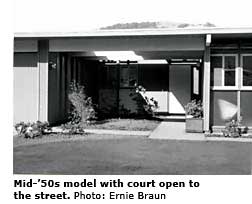
But it is true that the atrium didn't win wide popularity until after its official 'debut' in 1957-'58. Most Eichler 'courtyard' homes that preceded the reemergence of the atrium were basically C-shaped, with three sides of living space fronting the court, with the fourth side being a wall or carport. Other courtyard models featured three walls and a recessed court open to the street.

The atrium has proven so fascinating that the tale of its development has an air of historical romance. Ned Eichler, who was marketing manager at the time, has recounted his 'origin' story several times, including in a recent interview. It was 1957, sales were slow, and Eichler executives were kicking around ideas to speed things up. At one drawn-out and depressing brainstorming session, Ned remembers, architect Bob Anshen, of Anshen + Allen, was standing at the drawing board.

"At one point he drew what is an atrium. My father looked at it and said, 'What the hell is that?' And Bob said, 'It's an old, old thing, people used it long ago.' And he called it an 'atrium.'" But it wasn't a Eureka moment. "People at the meeting saw there would be construction problems," Ned says, and the atrium would require using additional materials. But Joe was intrigued, and after Anshen left, says Ned, "My father and I stood looking at all these scribbles."

August Strotz, who joined Anshen + Allen in 1956, remembers the atrium's birth a little differently. It was an architect-only session in the studio that included Anshen, Claude Oakland, and Strotz. They were kicking around ideas, as they always did, so it's hard to know exactly how the 'hole in the house' idea evolved, he says. "We would discuss design for hours and hours and hours," he recalls. "Then the two of us (Oakland and Strotz) would go sit down and draw this stuff." By the end of the session, he says, they had an outdoor room that was "surrounded by building and open to the sky." Strotz, along with Ned Eichler, credits Anshen with its invention. "Bob Anshen was the driving force in that outfit," Strotz says. "He was the designer and he was the idea giver."

Stephen Allen, Anshen's partner, told his origin story in a 1979 interview with Stanford graduate student JoAnne Wetzel: "The atrium house was done four or five years into the building of the Eichlers. Where did the concept originate? Bob and I both studied Latin. Perhaps that had something to do with the label. Of course, we both studied Roman architecture; that was the word the Romans applied. We'd also seen plans of Pompeii. And it was also affected by Eichler's purely economic view. With the atrium house, the secondary rooms had the privacy of opening onto the atrium."

In any case, say architects who worked at Anshen + Allen at the time, the design process was collaborative. "Bob was the conductor, like the guy with the baton. But the music was done in the background," Strotz says, meaning by "background" the draftsmen and designer Claude Oakland, who supervised them. "We were developing the ideas that Bob sprouted like the spring. He was a terrific designer."

Kinji Imada, who was later Oakland's architectural partner, also emphasizes the collaborative nature of design. "It was Claude's job to take Bob's ideas, redesign or refine them, and produce working drawings. It would be hard, if not impossible, to separate design and execution into working drawings - one is always designing as one works on working drawings."

"The way architects used to work in those days," says August Rath, who worked under Oakland at Anshen + Allen from 1957 to 1960, "Bob would say, 'Let's get all the ideas that we can. Let's get all the ideas out there.' So we would bust our buns coming up with everything we could think of." Anshen would contribute ideas of his own. "He was a great one with coming up with ideas that were oddball," Rath says. "Bob loved to go for something far out...This was not a closed show where Bob would walk around and say, 'Here's the plan. Let's draw it up.'"

One goal of the E-11, an Anshen + Allen plan from 1957-58, which Munson says was the first real atrium model, was to provide light without adding windows that would reduce privacy. "In those days we had mahogany walls," she says, "so rooms were already dark. It was like the black hole of Calcutta in rooms that didn't have two windows." Other goals were to provide additional outdoor living, improve circulation, and add drama, says Rath, who did early drawings for the E-11. "It was part of the bigger picture of the house," he says. Eichlers are focused on backyard living, with the front of the house saved for cars and bedrooms. "You're living out of the back," he says. "How do you get to the back in an attractive way?"

classic atrium

The answer, he says: "Enter through an almost windowless front facade into a bright sky-lit garden area, and make a most enjoyable short journey to the floor-to-ceiling glass wall and the bright and open living area, which in turn opens to the rear garden beyond through a similar floor-to-ceiling glass wall. The net effect being that there is little or nothing between you and the beautiful garden you're in, and the garden in the rear. Now that's living!"

The atrium also provided usable space for gardening and entertaining, Munson says. Strotz says its contributions go even deeper. "The atrium in my opinion had a tremendous influence on the family life," he says. "The family felt much more like a nucleus within. It gave the family a closeness which the normal house doesn't have."

Although most Eichler homes after 1958 include an atrium (or the skylighted 'gallery' that evolved from the atrium), non-atrium homes continued to be built. When Oakland designed a home for himself in 1959, it didn't include an atrium.

The goal, Munson notes, wasn't to build atriums. It was to build attractive, light-filled homes with access to the out of doors, and the atrium was just one solution. "It's not to atrium," she says, borrowing a line from Hamlet, "or not to atrium."

The E-11, like the larger E-111 that followed in 1959, fronted the street with two bedrooms and a garage, with a short entry between them leading to what the plans called an 'open court' surrounded by living space. These plans, and subsequent iterations, were built in Palo Alto and Terra Linda, and later in the San Mateo Highlands. Ned Eichler says the first atriums were built in Palo Alto. The plan is similar to earlier plans with 'courts' or 'courtyards,' including the E-5, except that in most of the earlier plans the court is bordered on one side not by living space or a garage, but by a carport wall of translucent glass.

Innovative as they were, Anshen + Allen's original atrium models failed to ignite sales, Ned Eichler says. "It was a very difficult time to sell houses," Ned recalls, and the design, with the atrium hidden behind a door and garage, turned off some buyers. "Now, people often criticized our houses as too boxy from the street," he says. "The atrium was worse -- it had no variety in the front."

So they tweaked the design by adding a lattice, he says. Then A. Quincy Jones, of Eichler's other affiliated design firm, Jones & Emmons, took a look. "He said,'We can solve this problem of it looking like a box." Jones' solution was to replace the two-car garage with a one-car garage and a carport to create depth in what had been flat façade, and to add a gable roof. "It made a tremendous difference," Ned Eichler says.

Munson, however, remembers that even the first atrium models sold well. "Buyers liked them very much, from the start," she says. In any case, the atrium proved a solid success. "By 1959 or '60 we could hardly sell a house without an atrium. It sort of trapped us," Eichler says. Its appeal, he decided, was aesthetic. The atrium provided a wonderful surprise, "a great visual entry." And, he says, "It created a greater indoor-outdoor feeling to the house when you were inside it."

plans

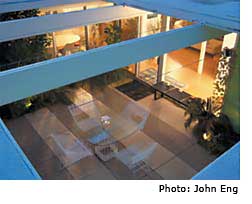
Purists point out that most Eichler 'atriums' are not atriums in the original sense of the word -- open-air courtyards completely surrounded by living areas of house. Even the classic Eichler 'atrium' remains an entry courtyard because it can be entered via a doorway and often a short covered hallway from the street.

By the mid-1960s, however, Eichler began building a few 'real' atriums designed by Oakland, including his 24 plan. "The 24 plan had an atrium that you didn't walk through as part of the entry," Munson says. "It was truly a hole in the middle of the house." The 24 was built in Lucas Valley and Burlingame in the mid-1960s. This was followed by Oakland's 34 plan, which converted the atrium into a skylighted, multi-purpose gallery room that retained much of its outdoor feeling, even though it was no longer open to the air. "It was wildly popular," Munson says, "and still is."

One Eichler customer who appreciated the true atrium was Joe Eichler himself, who had Oakland design him an octagonal home in Hillsborough in 1972 with an atrium completely surrounded by living space.

Ultimately, as Eichler fans and design aficionados point out, it doesn't really matter how the Eichler atrium came about, or even how it is defined. "Who came up with the idea is of less importance than the intelligence of the architects to produce great designs, and the brilliance of Joe Eichler to understand the beauty of the idea, and to gamble on its acceptance by the public at large," architect August Rath says. "Luckily," Rath continues, "Eichler built in one of the most beautiful areas on the West Coast where the intelligence quotient of its inhabitants is quite high. And thus these homes can be found all around the Bay Area, enjoyed by all that live in them."


See other Eichler Modern Stories


dura-foam solar center

preferred service companies

Top of Page

pixel

The Eichler Network
info@eichlernetwork.com