

key con construction and design  dura-foam solar center  nil erdal realtor
Eichler Network CA Modern
ca modernmagazine cover
To Get
CA-Modern
Magazine
Click Here
los angeles conservancy
pixel
HOME | ABOUT | CONTACT | ADVERTISE
abril roofing


transparent pixel
Feature on File

FROM RUSSIA WITH MODERNISM
Born nearly a century ago, the enchanting theremin
is still ahead of its time -- struggling to be heard

From the pages of CA-Modern magazine
By Jeff Kaliss

thereminist

Brian Wilson had a mid-century moment with the theremin years before he put the musical instrument to use in the Beach Boys' chart-topping 1966 hit 'Good Vibrations.'

As a Southern California eight-year-old in 1950, "My mom and dad took me over to a friend's house," Wilson recalls in the award-winning documentary, 'Theremin: An Electronic Odyssey.' The friend began playing the theremin, "and I was scared to death of that sound," Wilson continues. "It sounded like one of those scary movies. It was almost sexual."

To this day, many associate the sound of the theremin with themes of invaders from outer space in mid-century science fiction flicks and with the trippiness of 'Good Vibrations.' These associations continue to cloak the theremin's integrity as a legitimate musical instrument.

Nonetheless, the theremin is distinguished as the world's first musical instrument based on electronic circuitry and the only one that does not have to be touched to be played.

The theremin has moved across repertoires -- from classical to film soundtracks to New Age to lounge music -- but 88 years after its invention by the Russian for whom it was named, the theremin remains an object of fascination as much as confusion and underestimation. It's also a source of mysterious sound, which can suggest a spectral, wordless vocalist or an enchanted violinist from another world.
thereminist

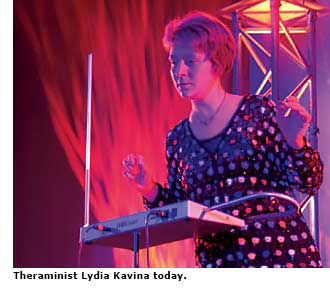
Lydia Kavina, granddaughter of the late Leon Theremin's first cousin and one of Theremin's last pupils, laughingly recalls the affront of a fellow Russian, composer Vladimir Martynov, at the Tschaikovsky Conservatory in Moscow, where Kavina studied music theory and composition, as well as traditional piano, but championed the theremin.

"He would say, 'Lydia, I like your performance so much, and I like you as a musician so much. You are such a beautiful musician. But, please, do not play theremin!"

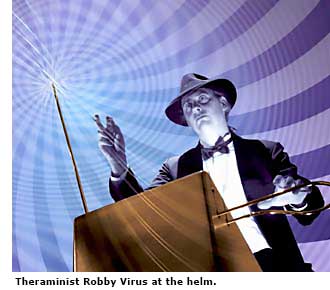
Robby Virus (that's his stage name) has found that his role as thereminist in the San Francisco lounge band Project: Pimento is sometimes misconstrued. At one recent performance, a woman approached the band's drummer, Aaron Wallbanger, during a break. "You guys are really good -- it sounds great," she enthused. "But I don't understand why you have this guy up there miming to all the songs."

The fan's impression was understandable. Virus's theremin, an Ethervox model manufactured by the North Carolina-based Moog Music, looks like a large wooden cabinet with a metal antenna extending vertically from its right side and another piece of metal looping horizontally from its left side.

Virus creates musical notes by varying the position of his right hand in relation to the antenna, and controls the volume with similar movements of his left hand around the loop. To the uninitiated, it might seem like the waving motions of a mime, when in fact it's the result of years of musical training.
Kavina with her mentor theremin

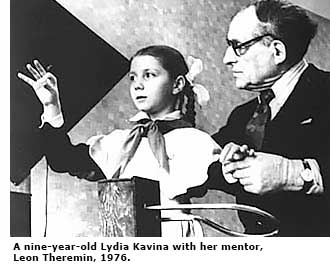
For Kavina, the training came at age nine, after several years of piano, directly from Theremin himself, who took an hour crossing the city of Moscow to get to her, after finishing his work at the Department of Acoustics at Lomonosov University.

"He always brought me cakes," Kavina recalls about Theremin, to whom she refers by his Russian name, 'Lev Termen.' "It wasn't like a teacher who comes to a kid's house and then gets his fee -- no way like that. It was really a nice communication between relatives...not that strict at all. It was an hour of making music together, let's say."

The atmosphere of love and respect with which Leon Theremin was greeted by his cousin's family sustained him through the frustrations of his day job, at which he struggled to put his creative and inventive mind to work for the benefit of the Soviet state.

"To be an inventor with new ideas, and at the same time an old inventor, it was quite hard," explains Kavina, who is currently based in England and speaks her adopted language with traces of a Russian accent and syntax. "And also, he had this name of being former prisoner," having been for years shut up in a 'sharashka,' a special-assignment detention facility, by former Soviet despot Josef Stalin.
theremin the inventor

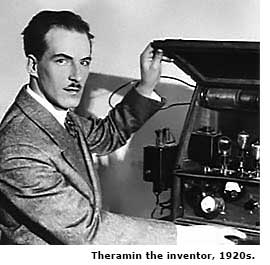
Theremin's career had evolved alongside the Soviet state, but expanded way beyond geographic and ideological borders, and ultimately outlasted the USSR. He was born in 1896 in St. Petersburg, the grandson of the Tsar's court physician, and was already experimenting in the new field of electronics by the time the Russian Revolution had dethroned and executed Tsar Nicholas II, in 1918.

While devising an apparatus to measure the density and electrical properties of gases under varying conditions of pressure and temperature, Theremin found a way to make the gases 'whistle' through earphones. An unexpected and fateful side effect was that the whistle altered in pitch with every nearby movement of Theremin's hands.

An amateur cellist, the budding inventor perceived the potential application of technology to music and fabricated a primitive loudspeaker so that his creation could be heard by others. In 1920, he was ready to demonstrate his 'etherphone' to a bemused group of students, for whom he performed Saint-Saëns' 'Swan' and Massenet's 'Elegy.'

Two years later, he guided the hands of Soviet leader Vladimir Ilyich Lenin through a performance of Glinka's 'Skylark,' and thus won official government approval of his new instrument.

After Theremin's marriage and Lenin's demise, in 1924, the military intelligence unit of the Red Army supported the idea of a European tour for Theremin and his creation, now called a 'termenvox,' hoping that the inventor might engage in technological espionage while showcasing his achievement on behalf of the Soviet state.

Positive press prompted an invitation from the United States, and Theremin was welcomed to New York in 1927 by the Fords, Astors, and Guggenheims, alongside other jazz-age glitterati and the upper crust of the classical music community.

trio

Tall and possessed of vulpine movie-star good looks, Theremin quickly gained an American following. He extended his stay, taking up residence in midtown Manhattan, formed a corporation, and in 1929 granted licensing and manufacturing rights under his patents to the up-and-coming Radio Corporation of America (RCA).

RCA renamed the instrument after its Russian inventor, and Theremin busied himself with performances and the creation of other theremin-like instruments, including fingerboard and keyboard models. In an ensemble dubbed 'The Electrio,' two of these models were combined with the original theremin and broadcast over the WJZ network in 1931. Theremin's later 'terpistone' invention elicited music from the body movements of one or more dancers.

the great thereminist Clara Rockmore

Less publicly, Theremin designed surveillance devices for American consumption while sustaining his status as an information source for the Soviets, serving as something close to a double agent.

Among Theremin's musical customers was a teenaged Russian expatriate and ex-violinist named Clara Reisenberg. Later to be known as Clara Rockmore, she took to the theremin as if born to it, quickly manifesting an accuracy of intonation difficult to achieve on the instrument, whose electronic design made it more inclined to approximate pitch and glissando.

Ultimately, through her performances and a few recordings, Clara became the abiding gold standard for thereminists, far exceeding Theremin himself and most who came after her. As noted in Albert Glinsky's authoritative biography, 'Theremin: Ether Music and Espionage,' "Clara devised her own hand positions and gestures. She found that by keeping the tips of her right-hand thumb and forefinger in contact, she could achieve steadiness and control in the vibrato. She also developed 'aerial fingering,' a system where individual fingers would extend and withdraw from the right hand for subtle, refined control of melody within the electrical field -- another technique adapted from violin."

Despite their age gap -- or perhaps somewhat because of it -- Theremin, estranged from his Russian wife Katia, came under the spell of the attractive and talented Clara, and began courting her. But in 1933 Clara married entertainment lawyer Robert Rockmore, taking his surname as her legal and stage name.

As Rockmore strived to validate the theremin's place in the classical repertoire, others began featuring the instrument as a novelty in popular bands, including the Hal Hope Orchestra, led by Samuel Hoffman, a chiropodist by day and a thereminist by night. As a precursor of its mid-century sci-fi function, the theremin was used as the buzzing sound on the popular 'Green Hornet' radio adventure broadcasts.

spellbound album cover

Theremin married Lavinia Williams, a black dancer 20 years his junior, but happiness and financial success in his adopted land eluded him. This aggravated his abiding homesickness. Under pressure from the KGB, Theremin secretly departed Manhattan in 1938 aboard a Russian freighter.

However much he may have been ready to leave, it has been widely assumed that Theremin had been kidnapped. In any case, his return to a nation now in the despotic grip of Josef Stalin did, in fact, prove menacing. He was arrested in 1939 and committed to several years of captivity, first in a Siberian labor camp and then in a less restrictive sharashka, where he was put to work enhancing the technology of Soviet aircraft. Theremin was afforded no opportunity to communicate with his wife, friends, and fans in the U.S., where he was given up for dead.

The instrument Theremin had left behind gained some notice through the war years in the hands of Clara Rockmore, and in Hollywood, where it invoked the threats of alcoholism on the soundtrack to 'Lost Weekend' and of mental imbalance in 'Lady in the Dark' and 'Spellbound.' The film work went to Samuel Hoffman, who'd relocated his medical practice to the West Coast.

Back in the USSR, Theremin helped launch the Cold War with a tiny prototype 'bug' he implanted in a wall plaque presented to the American ambassador. Finally freed from his prisoner status in 1947 (but not from the stigma), Theremin received from Stalin a reward of cash and a comfortable Moscow apartment, which he shared with yet another young wife, Maria Guschina. In 1948, the couple became the parents of twin daughters, Helena and Natalia, both destined to study the theremin.

populr elctronic magazine cover

American electronics hobbyists, after the War, shared plans for homemade theremins, among them one designed and built by Bronx high schooler Robert Moog in 1951. Throughout that mid-century decade, the status of the theremin as a source of spooky sound effects was reinforced by Hoffman's work in such popular sci-fi and horror films as 'The Day the Earth Stood Still,' 'The Thing,' 'The Five Thousand Fingers of Dr. T,' and 'It Came From Outer Space.'

Theremin pursued his interest in the interconnection between electronics and music into the Khrushchev era and the 1960s without much recognition or reward. On a Moscow visit with her husband in 1962, Clara Rockmore was thrilled to find her old flame alive, but she kept her discovery to herself, cautious about violating Cold War protocol.

Had Theremin remained in or returned to the States, he would have done well to have teamed up with Bob Moog, who on his way to securing a Ph.D. at Cornell had launched a business that included the manufacture of theremins. One of Moog's models was based on the inventor's original design (with an elegant but bulky mahogany cabinet), and another on more portable transistorized circuitry.

Moog theremins have continued to find favor with serious thereminists, wary of inferior imitations. "There are so many reasons why [the theremin] is not used as a legitimate musical instrument, and I think one is that there are many theremins that are not very well built out there," claims performing and recording thereminist Pamelia Kurstin.

The theremin sound sought by Beach Boy Brian Wilson for 'Good Vibrations' was performed by former Glenn Miller trombonist Paul Tanner on a device called the electro-theremin, a less-charming imitation of the original, with notes marked along an electrically charged strip.

bela lugosi pictured with theremin

"I thought, as long as we're doing something eerie today, why don't we get real eerie and put a theremin on it," Wilson remembers about the song's production. "It went to number one in the nation, and all because of the theremin and the cello."

The good vibes Theremin enjoyed while educating Lydia Kavina in the '70s were enhanced a decade later with the easing of restrictions brought by perestroika and glasnost under benign leader Mikhail Gorbachev. More than 60 years after his first successful tour, Theremin found himself able to showcase his instrument again in France and at Stanford University in 1991, where he performed 'Midnight In Moscow' to a standing ovation.

This reintroduction to the West of both Theremin and his musical creations was greatly furthered by Steven M. Martin's film 'Theremin: An Electronic Odyssey,' which won a Documentary Filmmakers' Trophy at the Sundance Film Festival in 1994. The film included footage of the nonagenarian Theremin in Moscow, of the long-widowed Clara Rockmore (15 years Theremin's junior) exhibiting her still-faultless technique, and of a touching reunion between the two former sweethearts in Clara's Manhattan apartment.

Theremin's last forays into research sought, among other things, the perpetuation of male potency and of life itself. Before he could finish, Theremin passed away in November 1993. But his contributions to music and imagination were sustained, partly through Martin's documentary, which, together with a lively collection of websites and blogs, helped launch a new generation of would-be thereminists into the New Millennium.

Among them is Robby Virus, a one-time student cellist whose stage name was based on his day job as a molecular biologist for a biotech company, and former rock and jazz bassist Pamelia Kurstin. Virus ordered an instrument from Moog, which arrived with an instructional video featuring Lydia Kavina, whom Virus later encountered at one of the international theremin festivals, begun in 1997.

kaatu and gork

For Kurstin, "It was because of how beautifully [Clara Rockmore] played it [in the film] that I was attracted to the instrument," she says. "If I'd heard anyone else playing it, I might not have heard the potential of the instrument, how beautiful and vocal it could sound."

Kurstin, an expatriate American living in Vienna, is known both for pushing beyond musical convention and for intoning bass lines as she accompanies other instruments, with her theremin set to a lower musical register.

After Brian Wilson, a handful of rock artists made use of the theremin, among them Jimmy Page (on Led Zeppelin's 'Whole Lotta Love'), Brian Jones (on the Rolling Stones' 'Please Go Home,' and Lothar and the Hand People. Many others followed. "The pop musicians were particularly important here, because they were always looking for new effects and new instruments," says Kavina.

Virus and the founders of Project: Pimento decided to go retro, choosing what they thought of as a mid-century name for what they claim is 'the world's only theremin lounge band.' "We wanted something for a cocktail lounge, on one hand, and on the other hand sort of a '60s sense of government spies, secret agents, a 'Man From U.N.C.L.E.' kind of thing," he says.

With his band now in demand at 'tiki festivals' and other gatherings of fans of lounge music and exotica, as well as at clubs and restaurants, Virus has learned to adjust the placement and settings of his theremin to avoid letting the electromagnetism of the venue and the crowd distort his 'pitch field.' "You can't be a perfectionist, and you can't be a prima donna -- you've gotta go with the flow," he advises.

beach boys album cover

Kavina, in her concerts and recordings, mixes in classical pieces with contemporary creations, including her own. She also occasionally plays with a Russian experimental surf band, and as a featured part of the visionary theater pieces of Robert Wilson.

Kavina enjoys the challenge, and points out that "new techniques have to be discovered with each new composition," including those created by composers with indications of shapes or hand positions instead of standard musical notation. "Each small movement makes a change of the sound, and the audience can very well see this," she points out.

Aside from her DVD instructional video, Kavina is sought after for personal lessons, and her accomplished students have included Germany's Carolina Eyck and Japan's Masami Takeuchi, both known for their precise intonation. The same degree of precision, alongside interpretive sensitivity, is applied to a broad repertoire, ranging from pop to classical, by Peter Pringle, younger brother of Canadian pop singer Anne Murray.

But eight decades after it enchanted the father of the proletarian revolution and some of the titans of American capitalism, the theremin and its growing number of virtuosi continue to stand apart as alluring aliens, eager for understanding and validation. Indeed, the theremin is an instrument still ahead of its time.


Photos: Jim Ferreira; and courtesy Mickey McGowan of the Unknown Museum, Project: Pimento, Lydia Kavina, Valerio Saggini, University of Maryland's Special Collections (Clara Rockmore Collection), Charles Richard Lester

• Discover more about the theremin and the fascinating world around it at Valerio Saggini's Thereminvox website.


THEREMIN ESSENTIALS

clare rockmire album cover

1. Clara Rockmore: Lost Theremin Album (Bridge); The Art of the Theremin (Delos)
Achieving near-perfect pitch and sensitive interpretation of a mostly classical repertoire, the late Rockmore raised the bar of theremin playing as high as it could go on both albums. She's accompanied mostly on piano, by her sister Nadia.

lydia kavina album cover

2. Lydia Kavina: Original Works for Theremin (Mode); Concerto per Theremin: Live In Italy (Teleura)
This cousin of the theremin's inventor moves through an interesting selection of mostly 20th Century classical music, New Music, and popular songs. She's stronger on the dynamics of the instrument than on intonation. Find the live set at cdbaby.com.

pamela kurstin album cover

3. Pamelia Kurstin: Thinking Out Loud (Tzadik)
In applying the theremin to her own avant-garde creations, Kurstin reveals both the inherent acoustic potential of the instrument and how this can be enhanced through state-of-the-art electronic effects. Some fascinating soundscapes result, challenging the listener.

peter pringle album cover

4. Peter Pringle: A Theremin Jewel Box; Many Voices (self-produced)
These two CD's cover the broadest repertoire for the theremin, both historically and across classical and pop genres. Pringle may come closer to Rockmore's accuracy of pitch than any other performer, and his approach is always entertaining and often surprising. From peterpringle.com.


dura-foam solar center
eichler solutions

Top of Page


pixel

The Eichler Network
info@eichlernetwork.com