

ronkey_1A  dura foam roofing solar center  nil erdal realtor
Eichler Network CA Modern
ca modernmagazine cover
To Get
CA-Modern
Magazine
Click Here
marin outdoor living
pixel
HOME | ABOUT | CONTACT | ADVERTISE
abril roofing
Loni Nagwani realtor
advertise here

transparent pixel
features on file

FALLING FOR A FUTURO
A tenacious California architect takes on the
restoration of his out-of-this-world dream home

From the pages of the CA-Modern magazine
By Dave Weinstein

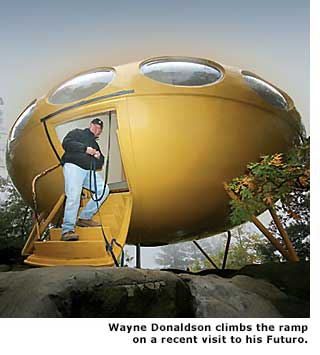
Wayne Donaldson and futuro

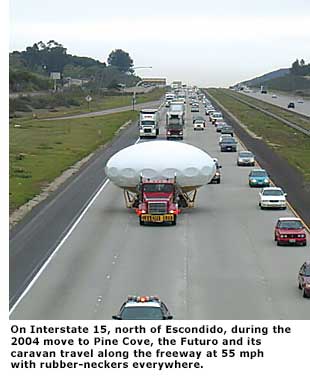
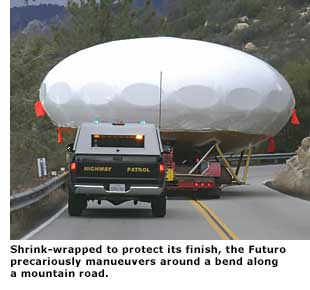
Hauling a vintage 10,000-pound saucer-shaped Futuro house 150 miles from the shores of San Diego to a remote rocky crag in the San Jacinto Mountains required months of planning, hassling with state and local officials, 'pilot cars' leading the caravan and protecting the rear, and Highway Patrol escorts shooing other motorists away.

The 26-foot-wide Futuro, mounted on a flatbed, took up the entire eastbound lanes of the Interstate. When the route headed up a narrow mountain road, men with chainsaws had to lop off tree limbs. The side clearance dipped to two inches.

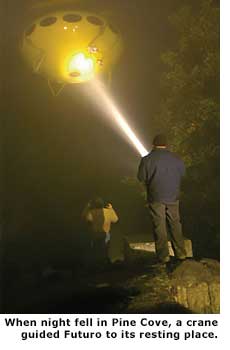
Then the crane that was supposed to lift the Futuro into place failed to arrive. The Futuro's owner, architect Wayne Donaldson, got on the phone and was none too polite. "Wayne doesn't take 'no' for an answer," says Larry Wood, who drove the flatbed.

Finally, Donaldson, Wood, and a few friends, including his contractor, Jim King, who organized the move and laid the foundation, had to grab the legs of the Futuro as it hovered over its new home atop a rocky peak, to swing it into its proper place. "The move was the most difficult thing I ever did in my life," says Donaldson, an architect, who has done many difficult things during his 63 years, including flying in an inflatable hang glider of his own invention.
futuro on the road

But the nerve-wracking Futuro move, which took place over five hours in December 2004, wasn't nearly as difficult as Donaldson's latest challenge -- to convince the world that his Futuro house is not a flying saucer. He might start with his friend Larry Wood, owner of San Diego Boat Movers. "We've moved a lot of strange things," Wood says, "but that's the first flying saucer house we've ever moved."

It's not that Donaldson doesn't get the resemblance. "Whenever you think of a flying saucer," he acknowledges, "this is the shape." It's just that the Futuro represents so much more, he says. To Donaldson -- who, as the State Historic Preservation Officer, is California's top preservation public official -- the Futuro is an important part of architectural and social history. It also represents a bit of Donaldson's own history -- or at least, of his dreams. What the Futuro represents, Donaldson says, is an optimistic vision of a future that never came to pass, when families would live in lightweight, inexpensive, durable, and easy-to-clean plastic houses they could move whenever the family moved.

The Futuro, two skins of fiberglass surrounding a rigid core of rigid foam polyurethane, could be hauled onto site in sections with furnishings, refrigerator, and oven, and assembled by two men and a crane in two days. "And it would fit sites like this," says Donaldson of his Futuro's present California mountain home at Pine Cove, near Idyllwild, above Palm Springs.
futuro at a bend in the road

People were dreaming in the postwar years of low-cost prefabricated housing, of mobile housing, of housing built using the latest technologies and materials. Durable plastic furniture, dishware, and hardware would make life easier for busy housewives who were suddenly getting jobs in business and industry. Fans believed the Futuro would make these dreams come true.

There were other plastic houses, it is true. Donaldson remembers marveling as a boy at the 'Monsanto House of the Future' at Disneyland. But that was a metal structure clad in plastic. "The Futuro House," Donaldson says, "is the first structural plastic house." It is also, at it happens, almost the world's only plastic house because, despite its name, the Futuro did not have a bright future. But its failure, too, is part of its historical value.

The Futuro was designed in the mid-'60s by the pipe-smoking Finnish architect Matti Suuronen as a prefabricated fiberglass-and-plastic ski cabin and manufactured starting in 1968 by Polykem, Ltd. But the Futuro was never aimed merely at ski bums.
futuro landing

After the Futuro received some praise and much press at several international shows, Polykem started assembly line production, and leased the concept to companies worldwide, including the Futuro Corp. in Philadelphia.

Soon there were Futuro ski cabins in Russia and a diner in Finland, a Futuro café in the Crimea, and Futuros atop Swedish Army lookout towers. 'Futuro: Tomorrow's House from Yesterday,' by Marko Home and Mika Taanila, the 2002 book that has helped rejuvenate the Futuro's reputation, estimated that about 60 Futuros were produced worldwide, 20 of them in Finland. 'Playboy' gave the Futuro a boost in 1970 with a spread (no nudes, alas) that made the Futuro's interior appear large enough to be a discotheque. "The ultimate 'Playboy' pad," the magazine called it.

The Futuro literature is littered with glittering projects that never came to be. A hotel in Kansas City planned to use Futuros as a 'VIP Outer Orbit Suite.' Skyscrapers were planned with slots for individual Futuros. "Since people are moving every five years," Donaldson says, "why not have a house that you can pick up, go to a tower, plug it in, and you're in the city of your choice?"

Suuronen and Polykem also produced a slightly more commercially successful sister house, the Venturo. A lozenge-shaped box with squared sides, it wasn't as flying saucer-like as the ellipsoid Futuro.

futuro in need of tlc

None of this, however, had much impact on the overall housing market -- though steel, plastics, and other industrial materials got a lot of ballyhoo. Joe Eichler never bought the idea, however, his son Ned Eichler wrote in his book, 'The Merchant Builders.'

"Most merchant builders had their doubts," Ned admitted, about what the magazine 'House and Home' was promoting as a 'truly industrialized house.' "At Eichler Homes we were especially skeptical," because of the company's experience building two steel-frame houses, including one, the X-100, which used plastic-coated exterior panels.

Donaldson himself was deeply involved with prefabricated plastic buildings at the time. A military kid who grew up around San Diego, Donaldson was always fascinated with technology. His favorite superhero was Plastic Man. From model airplanes he got into the hang gliding movement early, when it was build-your-own. Soon he was flying his own rigid-wing biplane hang glider. He also fell in love with inflatable plastic and worked on "inflatable designs that people could live in."

With a colleague, Donaldson worked on a prefabricated fiberglass-and-urethane-foam house, called a Poly-Pod, that was much like the Futuro. It went into limited production but didn't last.

futuro new window

The Futuro and its plastic brethren were done in by 1973. During that era's Arab oil embargo, when motorists lined up for gas, petroleum prices rocketed, Donaldson says. Plastic was no longer cheap, nor competitive with wood or metal as an architectural material. Embargo or no, the Futuro came with some built-in problems. It was small, oddly shaped, and expensive. Critics called it 'the Mercedes-Benz' of prefabricated houses.

Inside Donaldson's Futuro, the walls are curved, there's a built-in bench with under-seat storage, the 'kitchen' barely deserves the name, and the bedroom is only slightly larger than its built-in queen bed. The centerpiece of the living area is a fire pit and metal flue.

The elliptical acrylic windows are shaped like the house itself, as are the door handles. The two rows of windows originally didn't open. Building codes forced Donaldson to provide ones that do. The door is a ramp. Unlike the average mountain cabin, there's no outside deck.

futuro floor plan

The American version was altered to appeal to the American market, Donaldson says. But it didn't work. "I don't think a round house with non-operable oval windows was particularly attractive to a 1960s American housewife," he says.

futuro ad

The interior provides 500 feet of living space, not 300 as in Suuronen's original -- and without altering the exterior dimensions, Donaldson says. The American design accomplished this by raising the floor a few feet. Because of the revised plan, the kitchen sink backsplash cuts clumsily into the view from one of the windows.

The arrangement of windows also differs from the Finnish version, which had three rows. And the Finnish Futuro sat, like an egg in an eggcup, in a metal ring that attached to the spider legs. Here, the legs emerge from the Futuro itself.

The Futuro, buyers were promised, required no maintenance. "Just get out the garden hose and spray it off," Donaldson says. Not so, he adds. You don't need to scrape off barnacles, but in other respects it needs to be treated like a fiberglass boat. "Can you imagine anyone waxing this house?" he asks. "Just getting up on a ladder and not slipping off?"

But the Futuro has never appealed to people who care primarily about housekeeping. For Victoria Clarkin, who's been a Futuro fan since spending her high school graduation weekend in the famous beachside Futuro at Pensacola Beach, Florida, the appeal proved irresistible. "I just knew the spaceship was going to own me one day," she says.

futuros on a hillside

Clarkin owns a Futuro with her husband, Mark, who's been known to dress like an alien. They use it as their beach house. The house has withstood Hurricanes Ivan and Dennis ("It's round and aerodynamic, so when rain and wind hit it, it doesn't get too damaged," Victoria says) and hordes of tourists who beg to get inside. On a busy beach day, Clarkin says, 500 people take a photo of the Futuro. They often place aliens in the windows, and at Christmas, aliens wearing Santa hats.

Matti  Suuronen

For one Halloween -- "a big mistake," Victoria recalls -- the Clarkins informed the local newspaper the house would be open to the public. "We had people coming all the way from Alabama. The line was down the ramp, down the street, and around the block."

Clarkin, who says she is psychic, claims her Futuro, which she nicknamed the 'Spaceship,' is home to a ghost dog. A black cat -- named Astro, of course -- just can't stay out -- even when the Futuro "is locked up tight as a drum!"

"Wayne Donaldson would never agree with any of this," she says. "He's so scientific."

The Clarkins' Futuro sits atop a 1950s-era concrete beach house. Clarkin has turned the Futuro and the house into headquarters for the Pensacola Beach Preservation and Historical Society, and may eventually hold meetings there.

Many fans see the Futuro as nostalgia -- a spaceship fit for Barbarella, with smooth, sybaritic curves. The Futuro provides a mid-'60s vision of the future that was already falling out of touch with the zeitgeist by 1968 -- more Dean Martin and Hugh Hefner than Crosby Stills and Nash -- and certainly out of line with the Mothers of Inventions song 'Plastic People.' ("I'm sure that love...will never be... a product of...plasticity").

San Grau futuro owner

The Futuro represented an optimistic view of technology as a force that would solve man's problems. Gaining steam, however, was the fear that technology was running amok.

There's nothing about the Futuro that suggests the whole grain, communal, build-your-own-yurt movement. Donaldson himself, a child of the '60s, was also too techno to be a hippie. He recalls camping with a group of friends who called themselves the West Coast Electric Campfire Group, with "everything we could get in the market that you could plug in. We were looking at modern uses, modern materials to solve problems, rather than retreating back into the woods to find an alternate lifestyle."

The first time Donaldson saw his Futuro, it was painted red, white, and blue and was serving as a naval recruiting station in San Diego. A few years later he came upon it again, painted green and slated for demolition. "I said, 'gosh -- don't demolish it,'" Donaldson recalls.

Wayne Donaldson inside and futuro on site

By this time his architectural career had switched from designing high-tech structures of plastic to preserving buildings from the past. Besides working as a preservation architect on many historic buildings, as the State Historic Preservation Officer, Donaldson has helped to save many others, and to educate the public about the value of historic buildings.

In fact, it was Donaldson's staff at the state's Office of Historic Preservation that worked closely with the Eichler 'Historic Quest' committee to win spots on the National Register of Historic Places for two Palo Alto Eichler neighborhoods.

Donaldson understood that the Futuro, which once had a brave future, was now something from the 'Past-o.' There are only six Futuros remaining in the United States that Donaldson has been able to locate, and most are in dire shape, he says. He's visited all but one.

futuro book

Donaldson, who owns the only Futuro sited in California, bought his to restore it to its pristine original condition, complete with shag rug. "It's hard to clean, it looks like hell," he says of shag. "It looks like an old matted dog."

But Donaldson is following the strict Secretary of the Interior's Standards for Restoration. He hopes one day to get the house placed on the National Register of Historic Places. Once the house is restored, Donaldson will use it as a getaway. Inside, he says, "It's actually very quiet, extremely quiet."

Charles Castle, deputy director of the Museum of Contemporary Art in San Diego, was thrilled when Donaldson, whom he called "one of the greatest preservation architects ever, in our region," bought the long-derelict Futuro. "We knew he was somebody who really cared about the history of the Futuro."


Photos: Adriene Biondo, John Eng, John Gibbons (courtesy ZUMA Press, Inc. and San Diego Union-Tribune); and courtesy Wayne Donaldson, Matti Suuronen

dura-foam solar center


Top of Page


pixel

The Eichler Network
info@eichlernetwork.com