

key con remodeling fair  dura-foam solar center  nil erdal realtor
Eichler Network CA Modern
ca modernmagazine cover
To Get
CA-Modern
Magazine
Click Here
kitchen contest pick a winner
pixel
HOME | ABOUT | CONTACT | ADVERTISE
abril roofing


transparent pixel
features on file

SUMMIT ON HIGH
Once a tower of controversy and Eichler's dream,
meet this legend of 'non-pretentious elegance'

From the pages of the CA-Modern magazine
By Dave Weinstein

the eichler summit

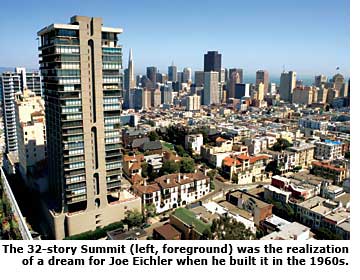
Thanks to a swooping silhouette that is visible for miles and a reputation as one of San Francisco's swankiest condominium towers, the Summit remains a legend. But it's a paradox as well, both one of Joe Eichler's best-known buildings yet least acknowledged -- because only rarely does anyone call it an 'Eichler.'

"They don't even know it's an Eichler," longtime resident George Gananian says of many residents, "and a lot don't even know who Eichler is." "If they know," says Walter Nelson-Rees, a 13-year owner, "they don't want to advertise it." Eichler, he points out, is seen as unalterably middle class.

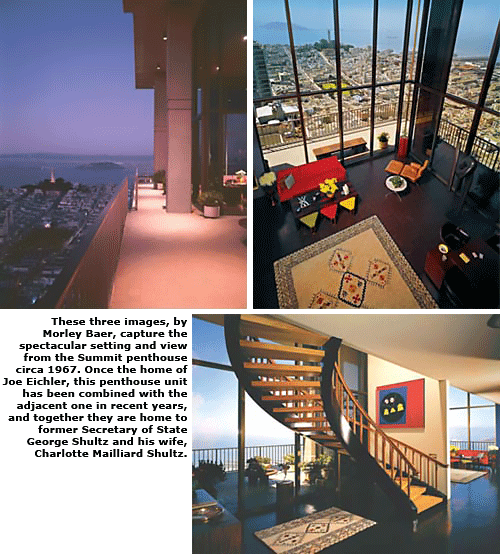
The Summit -- with 32 stories, including seven of parking; towering 330 feet above Green Street and more than 600 feet above sea level -- has more to offer than mid-century chic. Ask any owner -- any -- what appeals to them most, and the answer comes quickly: "Views." Nelson-Rees and his partner, Jim Coran, look out over downtown, the East Bay, and the Golden Gate Bridge through the floor-to-ceiling glass that makes up almost the entirety of the building's skin.

From Bob Long's condo, looking north towards Marin, you can hear the sea lions barking at Pier 39, beyond Fisherman's Wharf. Nearer to hand, the building offers views of the Russian Hill neighborhood itself, one of the city's most charming and historic, containing houses that helped create the Bay Area Arts and Crafts tradition designed by Willis Polk, Julia Morgan, and Joseph Worcester, and an octagonal house from the 1850s - all of which survived the 1906 Earthquake and fire thanks to brave and stubborn (soldiers tried to force them to evacuate) neighbors who fought the flames by themselves. Nearer to hand, the building offers views of the Russian Hill neighborhood itself, one of the city's most charming and historic, containing houses that helped create the Bay Area Arts and Crafts tradition designed by Willis Polk, Julia Morgan, and Joseph Worcester, and an octagonal house from the 1850s. They all survived the 1906 earthquake and fire thanks to brave and stubborn (soldiers tried to force them to evacuate) neighbors who fought the flames by themselves.

summit circa
1960s

THE SUMMIT
(a.k.a. the Eichler Summit)

Address: 999 Green Street, at Jones Street, atop Russian Hill in San Francisco

Number of units: 112 originally; fewer today
Height: 330 feet tall
Floors: 32 total: 24 residential floors, including two two-story penthouses, atop seven floors of parking
Built: 1963-'65
Designers: Tibor Fecskes, for the office of Neill Smith & Associates. Kinji Imada, of Claude Oakland Associates, handled the interiors
Other Eichler towers: Laguna Eichler (1963) at 66 Cleary Court; Central Towers (1964) at 350 Turk Street; Geneva Towers (1964) in Visitacion Valley demolished in 1998

summit logo

For Eichler, the Summit was more than another real estate venture. It was a dream. And when it was done, he dubbed it the 'Eichler Summit' and moved into one of its two two-story penthouses. The building also proved something of a nightmare, adding to financial problems that contributed to the sinking of Eichler Homes, Inc.

No such misfortune affected the Summit itself. For residents, the building remains a dream, although it has lost many of its modern, Eichlerian trappings. Almost every apartment has been stripped of the standard Eichler mahogany paneling. "They were awful," Gananian says. The original teakwood kitchen cabinetry -- forget it. Crystal chandeliers are easier to find than hanging globe lights. And floor plans have been completely altered in many apartments, thanks to interior walls that are non-structural.

Stephen Gomez, of Gomez and Patton Real Estate, a leading broker for luxury condos in the city, understands why buyers would want to modify their new homes. The Summit was built as an apartment house before being turned into a "first generation condominium conversion" in the mid-1970s. "So there's a built-in obsolescence in the bathroom size, the kitchen, the closet space," he says.

Built as apartments, the building was turned into condos in 1974 by Gerson Bakar, and Al Wilsey, the late food magnate who lived in the penthouse. Bakar, called by the 'San Francisco Chronicle' "one of the fastest shooting stars on the San Francisco real estate scene," bought the building the year before from Massachusetts Mutual Life Insurance. Like Eichler, who had worked many years for a butter-and-egg wholesaler, Bakar had a background in poultry. He grew up in Petaluma in a family of chicken farmers.

And over the years, the number of units has diminished as people buy up and combine adjacent condos. Some of the interior changes are legendary. Lola Bugatto has been living on the 28th floor for more than 20 years in a condo made up of three units. "I would say eclectic," Buggato says of her d ´ cor, which includes walls that are upholstered and adorned with many mirrors. "It's a very comfortable place indeed."

worcester cottage

Residents describe condos that have gone completely Asian, have bedroom hot tubs, restaurant-size kitchens (originally, kitchens were standard galley), and Las Vegas-style party rooms. "Many of the people who buy in here can well afford to put the same amount of money into changing it," says Bob Long, a retired scientist and academic whose condo is one of the few that remains largely original, at least in layout.

The lobby, once sleek and unadorned, today wears crown molding. "People didn't want modern furnishings," says Gananian, who was on the board during the lobby remodeling in the 1990s. And even the building's exterior integrity has been compromised, as individual condo owners have enlarged their units by turning balconies into living space and removing exterior railings.

The changes have at least the occasional resident riled up. "The building is a very distinguished structure that I don't think should continue to be attacked," Nelson-Rees says. Still, the essential silhouette of the building remains intact, as does the Eichler-style wall of windows -- and radiant heat. And the building still has one characteristic that defines modern California architecture, what one resident calls "non-pretentious elegance."

Unlike the typical suburban Eichler subdivision, however, the Summit never attracted buyers motivated by a love of all things modern. "I don't think you're seeing people rush there because it's 'Eichler,' or rushing to the building because mid-century architecture is their thing," Gomez says.

The building differs from the typical Eichler neighborhood in two other ways as well -- it's relatively insular, not neighborly. And it is not, and never has been, a place for kids. (One of the relatively few children who was raised at the Summit, Sean Wilsey, son of Al Wilsey and former society columnist Pat Montandon, told all last year in his memoir 'Oh the Glory of It All.')

Residents -- who include some of San Francisco's wealthiest people, some who have lived there for decades, and others who had to dig deep to afford smaller units -- value their privacy. But they are always cordial when they meet on the elevator or in the lobby, says Jim Coran. "There isn't a community room where people come and chat," he says, "and I don't think there's a sense of need of one either. People don't come here for a sense of community."

resident bob long

But people do tend to know their immediate neighbors, says Bob Long, who lives in one of the building's smallest units. "We tend to be like little countries, floor by floor," he says. "The kind of people who live here are people of standing in the community," says Don Reid, president of the Summit Homeowners Association. "They are people of importance in the city."

The most prominent current residents are former Secretary of State George Shultz and his wife, Charlotte Mailliard Shultz, San Francisco's much-admired chief of protocol, who live in what now serves as a single penthouse. Former residents included radio personality Don Sherwood, who was famous for his parties, and actor Michael Douglas, who made the building his home while filming 'The Streets of San Francisco.'

Although more young people are buying units, residents say, retirees are more common than young marrieds. It's a cosmopolitan crowd, with an increasing number of Asians and Russian ´ migr ´ s. Gomez estimates that half of the units serve as second homes. Many of the condos are pied-a-terres that are rarely occupied, neighbors say.

architect feskes

Gomez says the Summit has retained its appeal over the years, even as the city filled with new condo towers, often with more amenities -- including exercise rooms, more common spaces, and pools. "It's always been highly regarded. That building is known for having very high quality management and a very competent homeowners association," Gomez says. "It's perceived in the community as a well-run building."

There is much to like about the Summit, even beyond its views. Its location is perfect for fans of city living, residents say. Nelson-Rees and Coran enjoy walking to the theater and other cultural events. This is very much a pedestrian-oriented community, with many residents walking the steep slopes to North Beach, the Wharf, or Nob Hill, each only minutes away.

The steepness adds to the buildings appeal, to some. "That's one of the things I like about the place," Long says. "I get my exercise." Walls between units are solid, residents say, so the building is quiet. "We do hear every fire engine in town," Coran observes.

The biggest complaint? The lack of a freight elevator, which is especially troublesome on days -- most days, it seems -- when someone is using one of the two passenger elevators for a remodeling job. "They call it Home Depot around here," Nelson-Rees says. "Material goes up, material goes down. An old toilet goes out, a new toilet goes in." Waits for the one-remaining elevator can be long.

Architect Tibor Fecskes, who designed the Summit while working for Neill Smith & Associates, says Eichler never asked for a service elevator -- though he kept an eagle eye on the project from an apartment he rented nearby for that purpose. "I think it was on the fifth or sixth or seventh floor," says Fecskes, 87, who lives in Sausalito, where pictures of the Summit still decorate his studio. "In the corner window he [Eichler] set up his binoculars to watch the construction. Over the phone he was communicating with the construction manager. He really wanted to build something significant," Fecskes recalls.

Eichler chose a prominent site on the summit of Russian Hill, which was occupied by a house designed by Julia Morgan. The owner was Neill Smith, who sold it to Eichler with the proviso that his firm would do the design. Soon, Fecskes said, the design work fell to him. The Summit became the only Eichler neighborhood that was not primarily designed by one of Eichler's regular teams of architects. Claude Oakland, whose firm was relegated to the interior appointments, didn't mind the arrangement, says Fecskes, who knew Oakland.

resident jim coran

Soon, working with structural engineer Steven Medvedowsky, Fecskes was designing a reinforced concrete tower whose post-tensioned concrete slab floors cantilevered from a central core and were further supported by piers that swoop up from the ground in the shape of a catenary curve. (To get a catenary curve, tack two pins to the wall at an equal height and suspend a chain between them.) "What is the most beautiful curvature? Obviously, the gravity curve," Fecskes says. "You cannot beat it, and all the curvatures in the building are like that."

Another unusual facet of the design is, each floor above the 24th cantilevers out just a foot further than the one below. The result is added square footage -- and added value. "It's very unusual," Fecskes says. "It works against perspective. You look up at a building, it's usually tapering."

Fecskes came to admire Eichler, whom he met virtually every day during design and construction, and believes the feeling was mutual. "He was the really rare developer who respected professionals, and was seeking out their advice," Fecskes says. "This is such an obvious and intelligent way to operate for a general who is in charge, and makes the decisions."

Fecskes remembers watching Eichler negotiate over the phone for the window walls that would clothe the Summit. "When he got a quote from one company, he said, 'Wait a minute.' Then he called the other company. He told them the offer. 'Can you beat it?' So he arrived at a lower bid. That was the manner he operated. Very smart."

The Summit provoked much controversy during the '60s because of its height, in a historic district primarily of single-family homes and smaller apartment buildings. Objections by neighbors to the Summit, and to other proposed high rises both on Russian Hill and elsewhere in the city, convinced the Board of Supervisors in 1972 to reduce height limits throughout much of the city.

Apartments in the new luxury high rise sold quickly, says Eichler's longtime sales associate Catherine Munson, who'd had more experience marketing middle-class homes in the suburbs. She didn't alter her sales methods, Munson recalls, but adds: "I did buy better clothing to wear. It's the city. You have to be more dressed up."

"The exterior appearance was very important," she says. "That gorgeous structural element was stunning. It really caught people's eyes."

It still does -- even if people don't know the Summit is an Eichler. "The building speaks for itself," Bob Long says. "You don't have to know it's so-and-so's building to want to live here."

How high is the price for change?

The membership of the Summit recently voted down plans to fill in the open-air plaza that separates seven floors of parking from the residential floors. The plaza is almost at the same level as neighboring street, Russian Hill Place, and provides a view. The recent plan called for an exercise room as well as meeting space. Bob Long was one of the 'no' votes. "One of the pieces they were going to put in the exercise room was a stair climber," he says. "The people can't go outside?"

The vote, which required a majority to pass and was weighted according to size of unit, was approximately 44 percent aye, 27 percent nay, 28 percent abstain.

The plan, for a "a stylish, glass enclosure on the plaza level," with 5,500 square feet of space, evolved from a desire by residents for recreation and meeting space, the association president Don Reid says. "I thought it might have been nice to go down there for exercise, and I like the idea of having an additional room for entertaining and concerts," Buggato says. But other residents opposed the project, in part because of the cost.

Nelson-Rees, a retired scientist and former art dealer, also opposed the plan because it would have changed the buildings' appearance, and filled in an open view area used by neighbors in low-rise houses on Russian Hill Place and Vallejo Street. He even contacted Tibor Fecskes, the building's architect, and learned that Eichler had deliberately left the plaza open to appease neighbors, who strongly opposed construction of a high-rise tower in their neighborhood.

Officials told Eichler the city would approve the building only if neighbors approved, Fecskes said in a recent interview. "Without the plaza," he said, "we wouldn't have gotten approval."

vintage photos eichler and work
in progress


Photos by David Toerge, Morley Baer (© 2006 by the Morley Baer Photography Trust, Santa Fe, New Mexico. All reproduction rights reserved), courtesy Tibor Fecskes.

pixel

Top of Page


pixel

The Eichler Network
info@eichlernetwork.com