

key con construction and design  dura-foam solar center  nil erdal realtor
Eichler Network CA Modern
ca modernmagazine cover
To Get
CA-Modern
Magazine
Click Here
los angeles conservancy
pixel
HOME | ABOUT | CONTACT | ADVERTISE
abril roofing


transparent pixel
Feature on File

PREFABULOUS OR FAD?
Designers and builders of prefabricated homes
go modern and green -- but what lies ahead?

From the pages of the CA-Modern magazine
By Dave Weinstein with Joe Barthlow

Marmol
Radziner Desert House

Is America heading for a prefab future?

Instead of hammering homes together stick by stick, will builders assemble them in climate-controlled factories and then truck them to the site readymade? Will we replace archaic techniques of homebuilding that haven't changed much since the 19th century with methods that are more efficient and environmentally friendly?

And will all of this lead to a resurgence of well-designed modern homes?

If buzz were buildings, the answers would be yes. Young architects across the country are churning out sleek, hip, and ultra-modern 'weeHouses,' 'MetroSheds,' and 'Dockable Dwellings' that are as creatively named as they are designed. The plans are varied, ranging from steel frame to wood frame, from metal siding or plywood to composite panels. They are found all over the Internet and in the popular architectural press and are discussed at packed conferences. Some have even been built.

One of the few architects who has actually seen a goodly number of her designs built is Michelle Kaufmann, whose 22-person Bay Area firm has completed 12 prefabricated homes, has another five underway, and another 50 going through pre-construction paperwork. Also in the works -- a Benedictine monastery in the hills of Big Sur.
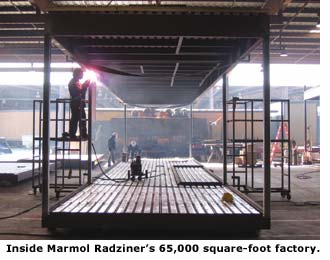
Marmol Radziner factory

All are 'modular,' which means they are constructed in a factory as large room-sized, or multi-room 'modules,' complete with walls, floors, ceiling, plumbing, and fixtures, then delivered on site where they are married to their fellow modules and attached to foundation and utilities. Kaufmann's firm will build nothing but modular, she says. "People ask, 'Is prefab just another fad?'" Kaufmann says. "I truly believe it's not a fad but it's a shift in the way we think."

"We think, long term, prefab will be the choice of home building," says Michael Friedman, whose firm Maxx Livingston Modern Homes is developing modular prototypes of designs by Los Angeles architect William Krisel, the primary designer of the Alexander modern tract homes in Palm Springs from the 1950s and '60s. "Having the ability to control quality and pricing, and also have a lower impact on the environment just makes long-term sense. Residential home construction is one of the last mass industries that has truly not taken advantage of line production."

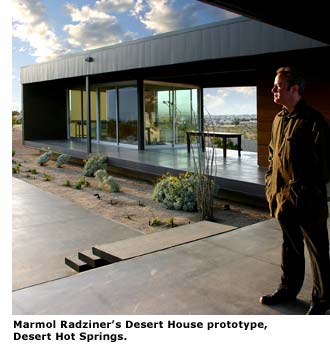
Marmol Radziner Prefab, an offshoot of the Los Angeles-based architectural firm Marmol Radziner + Associates, whose prototype modular home in Desert Hot Springs has attracted much attention, even runs its own 65,000-square-foot factory to produce steel-framed modules fully outfitted with plumbing, drywall, lighting, and tile work. What's most exciting about prefabrication, partner Ron Radziner says, is, "You can bring modern design to more people."
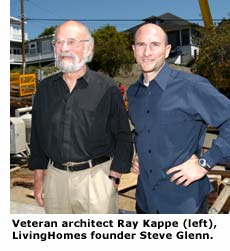
Kapppe and Glenn

Another proponent of modular homebuilding is Ray Kappe, whose recent modular house for the firm LivingHomes in Santa Monica has been called the best of the new prefabs -- by several of Kappe's competitors, no less.

That shouldn't be surprising. Kappe is a pioneer Southern California modernist who has designed hundreds of wood-and-glass houses since the mid-'50s, many of them floating over steep slopes thanks to his signature concrete towers. Everything he designed from the '50s on, Kappe says, anticipated prefabrication. (In the 1950s, working under contract with NASA, he developed modular housing units with portable power units that could break apart and be used as personal transportation!)

"It's kind of great," Kappe said in a recent interview, "to finally do a modular home at a point where you're ready to retire, and now you have an opportunity to do what you've always wanted to do."

Still, not everyone is convinced that prefabs have finally come into their own. Krisel, working with Maxx Livingstone, has a stake in their success and hopes for the best. But he says, "I've been an architect so long, I've seen so much talk about prefab, I'm not sure it will work now. Every time I've been involved with anybody wanting to prefabricate one of my designs -- and over the years that's been at least ten times -- we've always found that that you could build it with stick for less."

Prefabricated houses were a hot concept in the '50s, and had been since the 1920s, when Le Corbusier in France produced a 'mass-produced house,' followed shortly by Walter Gropius in Germany. In the United States, throughout the Depression, World War II, and the suburban boom that followed, progressive architects dreamed about producing affordable, modern prefab homes for farm workers, war workers, and returning GIs and their young families.

What is prefab?

Today's prefabricated houses are of two kinds:

• Modular, which means the house is built in the factory as a one- or more room-sized 'modules,' complete with walls, floor, wiring, finishes -- even built-in furniture, if desired -- then brought to the site via truck where they can be attached to other modules and to the foundation. Modular houses often arrive at the site in just a few pieces.

• Panelized, which means the house is constructed as a series of sections, often wall and ceiling panels that contain wiring and insulation. The panels and other prefabricated elements, including kitchens and bathrooms, are assembled on site. Panels are often SIPS (Structural Insulated Panels). Panelized prefabs can arrive at the site in hundreds of pieces. Kit houses are a variant of panelized systems.


During World War II, Gropius and Conrad Wachsmann tried and failed to build prefab war housing in America. Buckminster Fuller gave it a shot with his 'Wichita House,' building a total of one. A critic dubbed it "Fuller's glorified grain bin." In 1950, even the builder of the now-legendary Lustron house -- which was steel-framed with enameled paneling -- went bankrupt.

There have been successes, of course, though few were modern in style. More than 200,000 prefab units were turned out for worker housing during World War II by dozens of builders. A century earlier, entrepreneurs who flocked to treeless San Francisco to profit from the Gold Rush imported 5,000 prefab homes, including Colonials and Carpenter Gothics, from the East Coast and Europe, shipping many around the Horn. And who can forget the Sears Roebuck kit houses, built from roughly 1900 to 1940?

The ubiquitous 'trailer,' later dubbed a 'mobile home,' remains an integral part of the American landscape, of course. But 'mobile homes' are not what architects mean when they talk about modern prefab. "It's a word nobody wants to use," says architect Bryant Yeh, whose Los Angeles firm Yeh + Jerrard has designed the prefab JoT house.

Nobody, that is, except architect Jennifer Siegal, whose Office of Mobile Design in Los Angeles really does produce homes that can move from site to site. Siegal has said she's responding to the "new nomadism."

"The early modernists put the prefabricated house at the center of their program of reform," Colin Davies observes in his book 'The Prefabricated Home.' "Architectural history may pretend otherwise, but the fact is that their prefabricated house projects all failed."

Why? The federal government, which in time of crisis threw money at prefabs, repeatedly grew bored and turned off the tap, Davies notes. Several of the architects, including Wachsmann, seemed more interested in designing ideal prefabs than in their actual manufacture. And the few prefabs that were available couldn't compete against conventional stick-built tract homes, which likewise benefited from efficient, rationalized mass production.

crew assembling an it

Today, however, is different, proponents say. Technology has improved, quality manufacturers exist (many have been producing modular school rooms), and there is pent-up demand for modern, affordable architect-designed homes. The last time middle-class people could really afford custom modern homes, after all, was in the mid-1960s.

Designers attribute the newfound interest in prefabs to the desire to save the planet through green design, design-savvy young people, and increasing housing costs that are forcing architects -- and buyers -- to come up with creative solutions.

Kappe also believes that 'Dwell' magazine helped stimulate interest by sponsoring recent competitions for well-designed prefab houses, and having the winner built in North Carolina. 'Sunset' magazine also worked with Kaufmann on the 'Sunset' Breezehouse. 'Time,' 'Newsweek,' 'Business Week,' and other publications wrote about the new prefab designs. "The press has been wonderful," Kaufmann says.

One thing that is not driving the newfound interest in prefab is a desire to produce something that's bargain basement. Chic, more than cheap, is what designers and buyers are after. "It's not really cheaper," architect Alan Koch says of prefab versus conventional construction, "but you get a better quality product for the same price."

In a factory, Friedman says, conditions can be controlled, and workers more closely supervised than on the typical building site. The result, he says, is better quality. And on site, the homes go up quickly -- often in a day, if they are modular; longer, if they are panelized.

Supplying what architects of the '50s and '60s called 'social housing' -- low-cost houses for workers or homeless people -- may not be the primary goal of the new prefabbers. But it is something that many hope to accomplish once production gears up. Instead, most architects' social concerns involve protecting the environment.

Koch

Prefab houses are kinder to the earth in part because they are smaller than conventional houses. "There are people who are attracted to the Mini-Cooper instead of the minivan," Koch says of his potential customers. "They are looking for something small and smart."

There is also much less waste manufacturing homes in a factory than on site, Kaufmann says. And most prefab designers promise to site their houses to reduce energy use, and use sustainable materials and non-toxic paints, and many outfit their homes with solar panels. Wind turbines are an option on Kaufmann's designs; they are especially useful for housing in remote spots that are off the electrical grid -- including the monastery.

Buyers include people who are committed to living easy on the earth, says Steve Glenn, the founder of LivingHomes. "I think there is a big chunk of people who care deeply about design and who care deeply about the health and sustainability of the products they buy, but currently buy homes that don't really reflect those values unless they have the time, money, and stress tolerance to do it themselves," Glenn says. "These houses fit people who love design and who love health and sustainability," he says. "The group could be called the cultural creatives, the conscientious capitalists." Buyers are also people who would like a custom home, without the custom-home hassles or costs, he says.

Not surprisingly, the new prefabbers are going after artists and those with an artistic sensibility. That's one reason Joshua Tree, a growing artists colony in the high desert east of Palm Springs, is home to several new prefab homes, with many more on the way, including houses that Bryant Yeh (of Yeh + Jerrard) and Alan Koch and Linda Taalman (of Taalman Koch Architecture) are building for their own use and to use as showpieces. Maxx Livingstone also plans to build Krisel prefabs in Joshua Tree, and Marmol Radziner has clients in town as well.

Friedman

Taalman Koch, whose biggest project was an art gallery, Dia Beacon in upstate New York, exemplifies the architect-artist connection that underlies much of the revived interest in prefab. The firm has collaborated with a number of artists on art project 'houses,' including Chris Burden's ten-foot high 'Beehive Bunker' made of premixed cement bags. For its iT house, a striking, aluminum-framed box that is almost entirely glass, a degree of privacy and a whole lot of art are provided by patterned, one-of-a-kind, artist-designed vinyl film (what Taalman Koch calls 'outFITs') that attaches to the glass.

One of their collaborating artists is Jim Isermann, who lives in an all-steel house in Palm Springs designed by Donald Wexler. "The owners are art collectors, and they got interested in the iT house because they wanted to collect some of his work," Koch says of his clients for the Isermann-decorated home. "They see the house as living artwork."

But it's not just the art-centric who are potential customers. Kaufman says she and her husband got into prefab when they couldn't find an affordable home in the Bay Area. Bryant Yeh and his wife are facing a similar affordability gap in Southern California. "Housing prices are spiraling out of control," he says, "so architects are looking at prefab."

Many of the new prefab homes are being built on small, urban infill lots, or in the hinterlands where land is relatively affordable. That explains the attraction of Joshua Tree. It's close enough to Los Angeles and San Diego, far less expensive than Palm Springs, and artistically cutting edge. "My theory about Joshua Tree is it's the new Malibu," Koch says. "It sounds like a crazy statement, but if you think about what Malibu was 60 years ago, it was the frontier, people had little beach shacks."

Modular homes can be cost-effective in remote areas, like Joshua Tree, where the price of labor drives up the cost of conventional construction. But as prefab grows more popular, driving costs down, it will be able to compete everywhere, proponents say. "We believe currently that prefab homes are best suited in areas where building traditionally may not be feasible," says Michael Friedman of Maxx Livingstone. "Over time we think this will change and prefab will become more of a dominant force within the residential construction industry."

Today, many buyers of modern prefab homes are seeking vacation homes. In the future, some say, buyers will include entry-level buyers seeking first homes. "I think the goal is to use this technique for affordable homes," Kappe says, "if you can get it down in price."

That's why some architects and developers, including Kappe and LivingHomes, hope to produce entire communities or prefab housing, including condos, to achieve economies of scale. LivingHomes is considering a community of starter homes, Kappe says, and so is Taalman Koch.

Yeh + Jerrard have a similar idea, Yeh says. "We're looking at building sustainable single-unit models that we can scale up, with the help of a developer. The payoff comes when you have economies of scale," he says.

Architect Ray Kappe remains hopeful but, like Krisel, cautious. "We'll see where it goes," Kappe says. "There's just a limited demand for high design modern architecture. Hopefully it will take off."


Sacramento's Streng Bros. dabbled with prefabricated homes in the 1980s, but without success. Why? See their 'Prefabricated Problems' story here.

Photos: John Eng, Barry Sturgill, James Watts, Benny Chan; also courtesy Clifford Public Relations, LivingHomes, Marmol Radziner Prefab, Maxx Livingstone Modern Homes, Michelle Kaufman Designs, Office of Mobile Design, Social Blueprint, Taalman Koch Architecture, Yeh + Jerrard. iT House outFIT

Illustrations: Conny Purtil, Barbara Bestor, Jim Isermann, Renee Petropoulos, Worthington/Kim

California's prefab crop:
7 modern models on the rise

Some of the most fascinating of today's modern prefab designs are emerging right here in California. Profiled below are seven of California's top candidates currently underway. Prices vary and do not include the cost of land or grading. Most of the houses have custom options. In general, the homes sell for $130-300 per square foot, which means a typical house would cost $250-350,000, without land, grading, utility hookups, or custom extras.


1. Taalman Koch Architecture: the iT House

What: The iT House
Type: Panelized kit house
Features: Constructed with a Bosch aluminum post-and-beam frame, a steel roof, and off-the-shelf parts, this 1,100-square-foot, two-bedroom design uses inch-thick glass panels around most of the house. Vinyl, decorative panels ('outFITs') designed by artists provide privacy and filter the light.
Where: Based in Los Angeles. They are starting one model in Joshua Tree. Two other iT houses are nearing completion.
Contact: www.tkithouse.com

it house

2. LivingHomes: the LivingHome

What: Ray Kappe designed the first line of homes for LivingHomes. "Not making it look like a prefab space was one of our goals," says Steve Glenn, the company's founder.
Type: Modular
Features: LivingHomes mixes green building technologies with modern aesthetics, and was awarded the first Platinum rating by the United States Green Building Program's LEED Home program for the model home in Santa Monica.
Where: Based in Santa Monica
How many: A steel-framed, 2,500-square-foot prototype was built in Santa Monica. Ten homes are under contract in California and a LivingHomes community is planned in Joshua Tree. A second line of LivingHomes is being developed with architect David Hertz.
Check out: The prototype house can be visited, by appointment (via the website), at 2914 Highland Ave., Santa Monica.
Contact: www.livinghomes.us

living home

3. Marmol Radziner Prefab: the Desert House

What: The Desert House is a prototype for Marmol Radziner's modular homes.
Type: Modular, steel framed
Features: Marmol Radziner builds its homes, based on a 12-foot module, in its own factory, and designs custom prefabs. Models come with modular decks, use eco-friendly materials, and can be equipped with solar panels.
Where: Based in Los Angeles
How many: One has been built in Desert Hot Springs; two are going to Moab, Utah, and Las Vegas; 18 more are under contract.
Contact: www.marmolradzinerprefab.com

marmol radziner

4. Michelle Kaufman Designs: the Breezehouse

What: The Sunset Breezehouse (1,890 to 2,470 square feet); the Sidebreeze (2,500 square feet); the Glidehouse (672 to 2,255 square feet). More designs are on the way.
Type: Modular, wood-framed
Features: The Breezehouse features an open, high-ceiling central breezeway living area, beneath a butterfly roof, flanked by sleeping and utility areas. Eco-friendly materials, high-performance insulation and mechanical systems, solar panels, energy efficient windows, a choice of siding. The single-story Glidehouse has a single-pitched roof and a wall of south-facing glass protected by movable wooden louvers.
Where: Based in Oakland
How many: Twelve homes are complete, five are underway, another 50 are in pre-production.
Contact: www.mkd-arc.com

breezehouse

5. Maxx Livingstone Modern Homes: the Krisel Butterfly

What: Maxx Livingstone plans a line of prefab houses designed by William Krisel, based on his designs from the 1950s and '60s for the Alexanders of Palm Springs.
Type: Modular
Features: These modular prefabs use nearly the same floor plan and elevations as Krisel's designs from 45 years ago. Base models of the Krisel homes are 1,625 square feet.
Where: Based in Canada and Los Angeles, initially working in the Palm Springs-Joshua Tree area.
How many: One conventionally built version is underway in Palm Springs and will serve as a showpiece home.
Check out: The showpiece will be constructed at the corner of San Lorenzo and Camino Real, Palm Springs.
Contact: www.maxxlivingstone.com


butterfly

6. Yeh + Jerrard: the JoT House

What: The JoT House (name comes from 'Joshua Tree')
Type: Panelized, using SIPS panels
Features: The stripped-down, one- to three-bedroom, post-and-beam box, roughly 1,300 to 1,400 square feet, has movable interior walls, a window wall, shed roof, stucco exterior, rows of clerestories, and a central core of bathrooms, kitchen, and laundry.
Where: Based in Los Angeles
How many: Two prototypes in Joshua Tree; another in the Silver Lake district of Los Angeles.
Contact: www.yehjerrard.com

jot

7. Office of Mobile Design: the Swellhouse

What: Several designs, including the Swellhouse, Portable Home, and the Take Home, by architect Jennifer Siegal
Type: Modular, and mobile
Features: Steel-framed, sleek, and boxy, and filled with glass, Siegal's mobile homes look like no one else's. Her modular homes are designed to be movable, open to customization, and to "rest lightly on the land." The Portable Home can expand and contract, and re-orient itself on the site to take advantage of seasonal sunlight.
Where: Based in Los Angeles
How many: OMD has turned out a number of mobile homes, an artists-in-residence community in Los Angeles called Ecoville, and mobile classrooms. Siegal has her own Swellhouse in Manhattan Beach.
Contact: www.designmobile.com


sweellhouse

Top of Page


pixel

The Eichler Network
info@eichlernetwork.com