


ronkey_1A  dura-foam solar center  nil erdal realtor
Eichler Network CA Modern
ca modernmagazine cover
To Get
CA-Modern
Magazine
Click Here
mod walls sign up for prizes
pixel
HOME | ABOUT | CONTACT | ADVERTISE
abril roofing
Loni Nagwani realtor
advertise here

transparent pixel
eichler house doctor

EXTERIOR SIDING
Sound advice and vigilant maintenance lead
to protection and lasting exterior beauty

By Jeff Nichols

jeff nichols

One of the most striking aspects of the Eichler homes is the attractive exterior siding that Joe Eichler incorporated in his home designs. Rather than using the standard plywood patterns of his day, Eichler created his own.

There are various stories of why and how Eichler produced his own siding, but the result was a series of patterns that for the most part are unique to Eichler homes. Though siding with Eichler patterns is no longer available in lumberyards, supplies for homeowners do exist within the Bay Area Eichler communities.

In his early homes, Eichler incorporated horizontally oriented siding, but by the mid-1950s he switched, with rare exceptions, to patterns with vertical grooves placed close together to more suitably complement his modern designs. Instead of using horizontal-lapped siding, which is more common today, he used plywood siding to create his unique patterns. The one exception was 'Plank-Tex,' a swirl-pattern design manufactured by U.S. Plywood. Not unique to Eichler homes, Plank-Tex can be found today on Eichlers in Foster City, Lucas Valley, and several other mid-'60s developments.

These three patterns are the most common siding styles found in Eichler tracts. However, there are a few exceptions, and these variations would likely require the expertise of a custom miller. With a little patience and a tape measure, it is easy to determine which siding pattern lines your Eichler's exterior. First, measure from the center of one vertical groove to the center of the very next one. This measurement is one that is 'on center.' Depending on your particular pattern, you will typically find on-center measurements of one-and-5/8 inches, two inches, or eight inches.
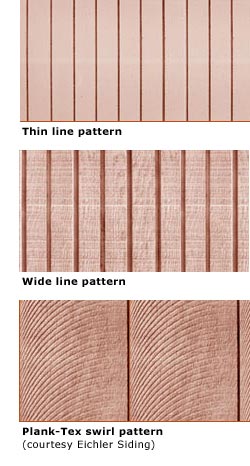
3 kinds of siding

Next, measure the actual width of the groove, which is the channel that is cut below the surface of the wood. Typical Eichler grooves measure 1/8 inch, 3/8 inch, or 1/4 inch in width. So, having done this, you now have two important measurements: your 'on center' distance and the width of the groove. Before placing your siding order, also determine the thickness of your home's siding. This can be tricky because many layers of paint may be present to pad the true measurement. But for the most exact measuring point, try the edge at the bottom of the siding. Most siding is 3/8 inch, 1/2 inch, or 5/8 inch thickness.

Unfortunately, consistency of siding thickness was not the norm in Eichler tracts. Thicknesses may vary from one pattern to another within a particular tract, and one pattern in one development may differ in thickness from the very same pattern in another tract. With that in mind, accurately measuring the thickness of your present siding becomes a critical step.

If the siding you order turns out to be slightly undersized in thickness, an installer can account for this difference by adding furring strips to the top of the studs. While this furring method is not preferred over replacing the old siding with an exact thickness match, it will allow the new sheets to be installed flush with the old ones. However, care must be taken when using furring strips; the nail length should be increased to ensure that the siding remains firmly against the stud. If you are unsure of your siding thickness, especially when approaching a do-it-yourself installation, defer to your siding supplier or an experienced installer or contractor.

As you enter your siding repair or replacement project, it also will be necessary to determine the overall size of the needed panel or panels. The panel height may be eight, nine, or ten feet -- or perhaps even measure somewhere in between these increments. Since plywood is now manufactured in standard 48-inch widths, this is the maximum width measurement available. The installer can best determine the exact amount of siding needed for your project. While one does not want to purchase too much, you still need enough siding to complete the job while compensating for the various siding widths that Eichler originally used. Another important issue is the actual texture and grades of the siding. Original Eichler siding was milled from plywood that was semi-smooth, exposing the natural wood grain. Without getting too technical, suffice it to say that today the choices of plywood textures and grades are limited. Some early Eichler homes used redwood plywood. Today, redwood plywood is almost impossible to acquire, and if found, is costly. In general, the choices presently are Douglas fir, and mahogany that is sold under the brand name of 'Breckenridge.'

Sadly, because plywood products are not nearly as high quality as in the past, plywood manufacturers use a technique to disguise the common blemishes found in exterior siding. This technique is called 'rough-sawn.' Rough-sawn material is literally roughed up at the plywood mill before it is shipped to wholesalers. This process creates a surface that is coarser than original Eichler siding. Even though replacement siding rarely provides an ideal texture match, Breckenridge tends to be less rough than its Douglas fir counterpart.

Another reason that the rough-sawn texture is employed today is because it creates what is called 'tooth.' Tooth is the absorbency factor that allows paint to penetrate deeper into the wood. This is a good thing, because greater paint penetration means better protection from the elements. Some Eichler owners request that the rough-sawn texture be sanded down. Indeed, with care, this can be done. However, one must be careful, because sanding away too much material creates a thinner top surface layer. This thinning can cause the plywood to be susceptible to premature splitting and delaminating.

The one exception to the rough-sawn products described above is a material called Medium Density Overlay, or MDO for short. MDO is a high-quality exterior material that weathers very well. It also has a unique resin-impregnated material applied to the exposed surface. To the untrained eye, this layer simply looks like paper, but due to resin that is assimilated into it, MDO is far superior to standard plywood. The drawback to MDO is that it is extremely smooth and exposes no wood grain. Nevertheless, many homeowners have found that when painting, applying primer and paint with a napped roller brings about textured results that suitably match the original siding.

All plywood siding must have what is called a 'shiplap' edge at the vertical joints. This allows the siding to overlap and provide a water resistant joint. Using plywood that does not have shiplap edging is not recommended; without it, water eventually will penetrate the seams and provide a thriving home for rot. Siding must be installed within local building code specifications. Check with your local building department to ensure you meet the code for nailing, spacing, etc. And beware of short cuts.

Some homeowners think they are taking a successful short cut by applying new siding over a preexisting layer. In actuality, this method can result is serious warping and buckling. The same kind of buckling can occur when installing the siding too tightly against other panels; appropriate spacing is required to allow for expansion and contraction.

Painting or staining Eichler siding often presents its own set of concerns. Staining brings out the patterns of the wood grain but offers less protection than paint. Staining the siding requires that the wood grain matches the preexisting siding so as not to appear incompatible. Consequently, when staining, one should consider texture issues and the occasional patches that appear on most plywood from today's mills.

Paint, on the other hand, provides better protection than stain, but when applied it covers up the siding's inherent grain pattern. A quality paint application affords the most protection against the elements and also hides minor siding imperfections well. When painting, the siding must be clean and dry and free from dust and grease. For best painting and staining results, always refer to the application recommendations the painting manufacturer provides. Purchasing the highest quality materials, whether stain or paint, and using proper application techniques, will result in dramatically greater protection of your investment for many years. Regardless of the type of new siding product you choose, make sure to prime both faces of each sheet and all edges before painting. This is an all-important preparation step.

Your exterior siding is the first level of defense against the elements. When installed and maintained well, it will provide lasting protection and beauty to your Eichler home. So, when repairing or replacing your Eichler's siding, be patient -- and seek out sound advice. You will not regret it.


Guest 'House Doc' Jeff Nichols and his partner and wife Annette have become a vital part of the Eichler community over the past 16 years with their Eichler Siding business (415-892-7754), manufacturing their own line of exterior siding.


See other Eichler House Doctor stories


dura-foam solar center

preferred service companies

Top of Page


pixel

The Eichler Network
info@eichlernetwork.com