

SLIDING GLASS DOORS
Slide with pride: a smart track to satisfaction --
our homeowners' guide to sliding door renewal
From the pages of CA-Modern magazine
By Tanja Kern
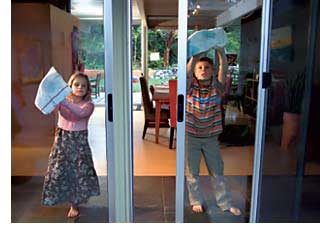
In mid-century modern homes, sliding glass doors are the definition of clean, modern living. They provide beautiful light for the home interior; offer an uninterrupted view to a captivating backyard or atrium; and when open, create a cooling breeze that prompts the family inside to breathe a sigh of relief.
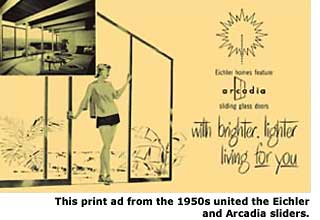
Minimal and modern, single-pane aluminum-framed Arcadia-brand sliding glass doors represented the technology of the 1950s and early '60s and were part of the Eichlers' original well-planned design. Simple handles let homeowners open these doors with little effort, and cleaning was a breeze.
"With the floor-to-ceiling glass, it fit right in, basically making a glass wall that only minimally blocked the view to the exterior," says John Klopf, an Eichler-specialty architect based San Francisco. "It has as much connection to the outside as possible. When the door is open, there's nothing there."
Over time, things can go wrong with the original sliders: rollers and tracks wear to the point that the doors are difficult to operate; the locking mechanisms break down; safety becomes a concern, especially with breakage tied to earthquakes and accidents; or owners want improved energy efficiency and savings. Some may look to a new sliding door as part of a home addition or remodel.
"If you're adding a door, you'll want to think about why you are doing it," Klopf says. "Is there a view, an access you're trying to gain for more light or air circulation?" What's more, how will the door capture light, and will it bring about unwanted privacy issues?
As with any major replacement in a home of historical value, aesthetics are key. "It is important to retain the original Eichler look as much as possible when replacing the doors and windows," recommends Dave Stellman of glass door and window dealer Palo Alto Glass.
Most modernist homeowners seem to agree. They want to retain the sleek appearance of their exteriors and opt for anodized aluminum window frames. "More people today have the good idea that you replace aluminum doors with aluminum, particularly in an original Eichler," says general contractor Henry Calvert of Calvert Ventures in San Mateo. "People are really aware of the look and, in my experience, are staying true to it."
Although aluminum frames look good, their biggest disadvantages are condensation and high thermal conductance, or heat transfer. Simple aluminum frames let heat out in the winter and in during the summer.
Door and window manufacturers today offer thermally broken frames, which reduce conductivity by splitting the frame components into interior and exterior pieces joined together by a less conductive material, such as plastic. In cold climates, a non-thermally broken aluminum frame can easily become cold enough to condense moisture or frost on the inside surfaces of window frames.
Because mid-century modern homes have large expanses of glass, window condensation is more noticeable than in other types of homes. In cooler months, the original single-pane glass, which has an R-value (a measure of insulating capacity) of less than 1, results in cooler air next to the inside surface of the glass than the rest of the air in the room. Moisture condenses on the inside surface of the glass.
Today's double-pane 'low E' sliders have R-values ranging from R-2 to R-4 and can help reduce the amount of humidity inside the house. Double-pane doors also make for a quieter interior. Low E glass has a transparent coating applied to its surface that separates long wave (heat) energy and short wave (light) energy. The long wave is reflected back to the heat source, and the short wave is allowed to pass through its coating to brighten the home interior.
Thermally sealed sliders are sealed against moisture. The insulating glass is made up of two sheets of glass separated by a roll-formed metal spacer tube all the way around the glass, which contains moisture-absorbing material. The glass is completely sealed to create a moisture-free air space between the panes of glass.
Homeowners also replace doors, as well as windows, for safety. Tempered glass, or 'safety glass,' which breaks into small pieces when struck, has been used in cars since the 1920s, but was not required in 1950s-era houses. The Eichlers were built with glass that can potentially break into dangerous shards upon impact or during an earthquake.
There are several manufacturers that carry aluminum-framed sliders that dovetail well into the door openings of Eichler and Streng homes. When replacing a slider, it's important to find a brand that can fit inside the existing door opening, thereby not impacting the aesthetic of the home.
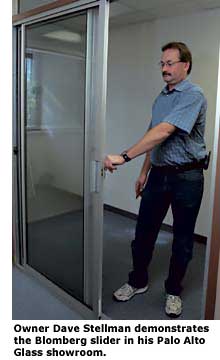
Blomberg Windows Systems' doors and windows feature narrow aluminum frames and double-pane insulated glass that maintains the open look. "I prefer the Blomberg brand because the frame width fits the four-inch by four-inch post depth," says Calvert. "The Blomberg frames are three-and-five-eighths inches in depth, and you can trim the inside and outside to look like the original." Since Blomberg frames are only one-and-five-eighths inches wide, there's a large expanse of glass to let in daylight.
On average, Blomberg sliding door replacements cost $2,500 to $3,500 (including materials and labor), depending upon size and transom glass configuration.
"They are a little pricey, but they are worth the extra premium because they fit the Eichler look so well," Calvert notes. He recommends that homeowners replace the six-foot-tall slider and transom configuration with eight-foot-tall glass doors instead. "It's a clean, cool look -- one that I have in my own home," he adds.
Most Streng homes were originally built with Blomberg sliders and glass, both of which allow for compatible upgrades, according to Ralph Blomberg, the company's owner.
"In these cases, you have no need to remove the existing perimeter frame and disrupt the exterior and interior wall finishes," says Blomberg. "The upgrade to dual-pane insulating glass becomes a simple process." New panels also come equipped with new rollers, weather stripping, and hardware.
Milgard Windows & Doors makes minimal-frame doors and windows that blend with modernist architecture, too. The 450-model sliding doors come thermally broken and have a tan, aluminum anodized, or bronze anodized finish. Low-E insulated glass helps reduce transmission of harmful UV rays and energy costs. A Milgard disadvantage is that their doorframes are five-and-one-quarter inches in depth, requiring them to be trimmed out beyond the original Arcadia openings, Calvert notes.
At the higher end, Bonelli Windows & Doors, based in South San Francisco, makes beautiful custom anodized aluminum sliders with a clear finish, bronze finish, or a powder coat that is available in a rainbow of hues.
Of course, contemporary versions of Arcadia sliders, the brand originally installed in Eichlers, are also available. Their sliders are shipped from the East Coast, and a contractor at the receiving end is needed to build a frame and assemble parts on site. Standard finishes include dark bronze anodized, clear anodized, painted white Duracron, and painted Quaker bronze Duracron.
Fleetwood Windows & Doors, which celebrates 50 years in business this year, has two aluminum sliding door products that also work well for the modernist look. The Norwood 3070 exterior multi-slide pocket door system and the Norwood 3000 traditional sliding door both come in four standard finishes, tan, clear aluminum and bronze, and a number of custom colors.
"Our vision is that people want product that's better rather than cheaper," says Fleetwood sales manager Mark McCoy. "We are going after the market that looks for something that is part of the architecture, and at windows as valuable." The company does have a budget pricing program, which allows homeowners, architects, and contractors to negotiate for a better price, but simple sliding doors could run $1,800.
For owners on a tighter budget, vinyl sliders are often a less expensive alternative to aluminum frame doors. Vinyl, also known as polyvinyl chloride (PVC), is a versatile plastic with good insulating value, high-impact resistance, and resistance to abrasion.
"It is not a secret, of course, that vinyl doors save much more energy than aluminum ones," says Sergiy Smelyansky, owner of Aurora Windows and Doors, a vinyl door and window manufacturer based in Redwood City. Smelyansky also points out that, unlike most other vinyl door companies, Aurora can produce doors of any dimensions. "And we do not charge additional fees for non-standard doors," he says.
Because a vinyl door's color runs all the way through the material, there is no finish coat that can deteriorate or become damaged over time. Recent advances have improved PVC's dimensional stability and resistance to degradation from sunlight and temperature extremes.
"From an aesthetic point of view, any architect will tell you that vinyl has no use being on an Eichler," says contractor Jonathan Cooke of Renaissance Man Construction in San Mateo. "But from a cost perspective, a lot of people go with them because they're more affordable, and because they don't have to worry about condensation."
The downside to vinyl doors is their commonly bulky frames, which most often are manufactured only in white or almond. Few vinyl manufacturers produce darker-framed doors (Aurora, among others, offers custom color coating for an additional fee), which are generally viewed as aesthetically more desirable for modern architecture. Dark colors, however, absorb more heat, making the door framing less energy efficient.
General contractor Regev Amir of Diamond Building & Construction in San Rafael recently completed a remodel on an Eichler in Lucas Valley that used Milgard's Style-Line vinyl series. "The client picked a brown color to stay with the old look and to match the house color," Amir says.
In this case, the homeowner opted to leave the doors the same size (eight feet tall) and installed a glass panel to the right of the door. "Milgard is not the best quality door," notes Amir, "but when used with the right colors and glass panels, they can sure make a difference, especially today, when budget is such an important part of a project."
No matter which brand or frame material they choose, homeowners should carefully consider the contractor they hire for door installations. A contractor familiar with modern design and construction can make a new door blend in seamlessly, complete with period-appropriate hardware. "They are going to understand the project and direct you to the right product for your home," Calvert says.
Most aluminum door brands typically are available with simple metal handles free of decoration that present a compatible, minimalist aesthetic. Companies like Slide-Co, a hardware replacement company based in Redlands, can usually source appropriate hardware for a project.
It's also important to understand the structural and legal requirements necessary for every sliding door replacement project. "If you're talking about replacing a door where there's already one in place, you don't have to consider the structural aspects too much," Klopf says. "But you should talk to an engineer if you're adding a door."
For most retrofit installations where a new doorframe is not needed, owners won't need to pull a building permit to replace a sliding door. When installing a slider that demands new frames, however, permits oftentimes are required.
For those homeowners with money to invest and a desire for greater connection to the outdoors, a NanaWall system may be a good fit. At first glance, the NanaWall looks like floor-to-ceiling glass windows, but in reality it's a series of glass panels that can easily open and stow away out of sight to create unobstructed views and access to the backyard or an atrium.
"This is good for making a room look and feel much bigger than it is," says Ebrahim Mana, president of NanaWall. "Homeowners will find they are using their outdoor space much more."
NanaWall panels can be hung from the top or the bottom and have a single thin track. Folding systems can create widths up to 36 feet, and individual panels can offer virtually an unlimited opening size. Swing doors are also available for fixed panels and one or two smaller openings. Made to order, the frames are constructed in aluminum, wood, or aluminum-clad wood.
The NanaWall system is energy efficient and recently received the Energy Star rating. Because the closed system remains air tight when closed, hot or cold air does not breach the barrier. This helps the inside temperature to remain at a constant level, cutting heating and cooling costs.
NanaWall utilizes insulated glass with low-E film to ensure proper insulation from extreme temperatures. The aluminum-framed models are thermally broken to prevent heat transfer. Prices usually run from $1,000 to $3,000 per panel. "NanaWalls are expensive, and if you are removing significant lengths of wall, you would have to put in some seismic strength and structural work," Klopf notes.
The bottom line for sliding door replacements is you get what you pay for. Quality, style, and functionality improve with price and a quality installation. "Everybody wants to be comfortable and enjoy the view," says Aurora's Smelyansky, "and these doors connect people to the world."
|