


key con remodeling  dura-foam solar center  nil erdal realtor
Eichler Network CA Modern
ca modernmagazine cover
To Get
CA-Modern
Magazine
Click Here
kitchen contest pick a winner
pixel
HOME | ABOUT | CONTACT | ADVERTISE
abril roofing


transparent pixel
home improvement

GREAT GARDEN WALLS
Fencing that extends your home's clean lines and
rigorous geometries into the wide-open outdoors

From the pages of CA-Modern magazine
By JC Miller, ASLA

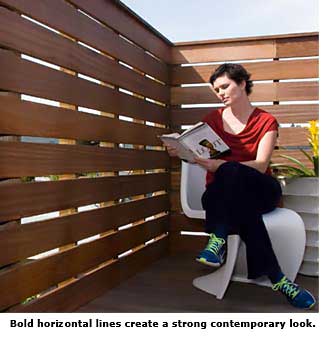
woman reading by fence

Fences are the walls of the garden room. They quite literally extend the structure and form of your modern home into the landscape, creating spaces for enjoying the out of doors.

But what makes up the composition and dimensions of a well-designed modern fence -- and how should fencing relate to the interior of the home?

"If all rooms indoors and out were the same size and shape," cautions master California landscape designer Garret Eckbo in his 1956 book 'The Art of Home Landscaping,' "our world would be a prison, and we would go mad. We all enjoy the contrast of open space with complete enclosure."

The most successful fencing in the modern garden takes its cue from the clean lines and rigorous geometries of house, building on the important relationship of indoor and outdoor space and expanding it all the way to the property line.

"The fence design needs to be compatible with the exterior façade of the home, and the transition from the building to the fence should be intentional and seamless," says David Thimgan, whose Thimgan Architectural Group has renovated dozens of Sacramento Streng and Eichler homes. "This can be achieved by using the same materials as the façade of the house, or with compatible materials that contrast. Carrying trim lines or other façade details form the house to the fencing can help achieve this blend from the home to the fencing."
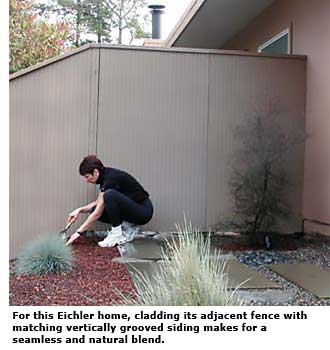
fence attached to house

Rustic stone, rough irregular textures, or ornately carved and ornamented wood structures are often at odds with the basic minimalist vibe of modern and contemporary buildings and are likely not the best choices for defining the boundaries of the gardens that enclose them. This does not mean that contrast is not a good idea, explains Thimgan, who sometimes utilizes contrasting materials to punch up the visual impact of his fence designs.

"Heavy and light materials are intriguing," he says. "There are a number of light open-weave metal screens currently being applied in commercial architecture that hold promise for residential fencing. In contrast to that, you have heavy and substantial materials such as cut stone and concrete. If done well, either of these will contrast nicely with the clean lines and smooth surfaces of a modern home."

Vertical textures that echo the patterns of siding or long horizontal planes that carry the line of a building wall outward are both appropriate design strategies for the modern landscape. Many of the original gardens created by prominent mid-century designers included fencing that had strong vertical character.
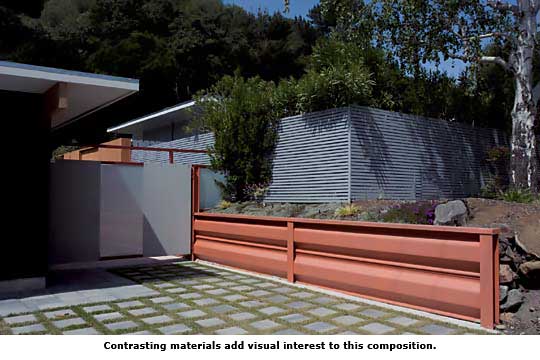
fence

Architect Lourdes Garcia of Garcia DeCredico Studio, based in the East Bay, has worked with many Eichler homeowners and believes that the vertical siding that is unique to those homes is another great material for fence-making.

"This type of surface texture offers a nice opportunity for the play of shadows throughout the day," Garcia says. "By cladding both sides of the fence with siding that is read as walls, the technique very effectively expands the visual presence of the home. Other texture materials, such as bamboo, also offer this possibility."
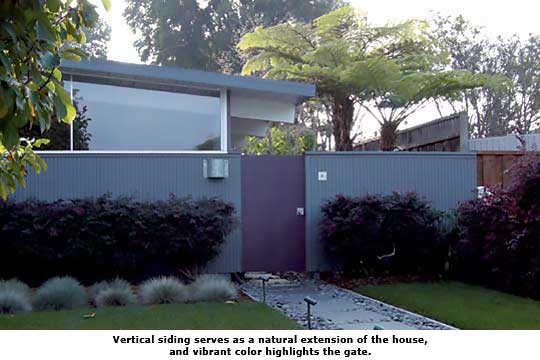
fence in front of house

Of course, horizontal patterns can also be found in photographs from the period, but fencing with a strong horizontal look is in many ways a more contemporary design approach. Either strategy works well, but if the goal is a garden with a 'retro' feel, a fence that includes a vertical pattern may be the more appropriate choice.

The amount of security desired is also a consideration when making the vertical versus horizontal choice. Obviously, fences that include horizontal members are easier to climb, so care should be taken with the design to minimize the use of the fence as a potential ladder.
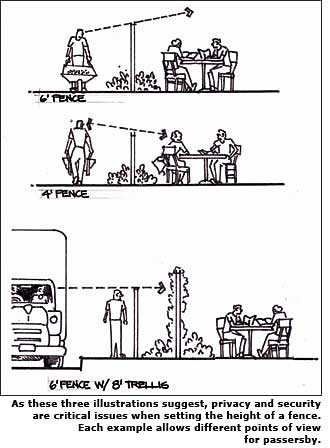
drawing of fence height views

Most municipalities have design standards that set the maximum height, and sometimes the materials that can be used in residential fencing. As a result, the six-foot-high-board property line fence is nearly universal design response from most builders and homeowners.

While functional, this basic approach to fencing does not make the most of the design opportunity or significantly enhance the character of the modern garden. Varying fence height, materials, and location can make all the difference -- adding a dynamic quality to what might otherwise be a basic box of space.

Height determination is one of the most important design decisions when planning a new fence. The six-foot standard is a good starting point for any design, but before a final fence height is determined, additional factors such as the sightlines required for maintaining privacy and outward views should be considered.

"On some projects, we intentionally keep the fencing low to allow for more expansive views," says Garcia. "In another situation, where the house might be located much closer to the neighbors, the fences are built high as possible. In both projects, the fence height responds to the design changes within the house, where we are opening up rooms and improving views to the outside. In the first case, we want to extend that view all the way to the distant landscape, in the second we use the fencing to ensure that the interior of the house has adequate privacy."

The walls of the outdoor room require a different scale than those inside the house. Indoors, the line of sight typically focuses on objects at or below the six-foot level, making the furnishings and floor more readily noticeable than the ceiling. In the garden, the eye is more likely to be drawn upward, towards the sky, rather than to the ground, so the six-foot level is perceived differently outdoors.

Obviously, the height of a standard property-line fence does not effectively block the sightlines to adjacent buildings or from uphill neighbors; so supplemental planting of hedges or trees that are not governed by height restrictions is often needed to ensure privacy.

modern fencing black and white

Local ordinances should always be consulted before finalizing a design. However, it should be noted that the height of garden structures -- a screen or trellis, for example -- that is set beyond the property line setback is not necessarily subject to the six-foot restriction. In such cases, it might be possible to achieve a greater degree of privacy or visual screening by extending the line of a building wall into the landscape at a height of eight feet or more.

The orientation of the house on the lot and the proximity of other homes are two of the factors that David Thimgan considers when determining an appropriate fence height.

"Fencing should always be tall enough to provide the security and privacy desired by the homeowner, but care should be taken not to wall off the lot," Thimgan says. "The design of a fence can allow for openings, or can use transparent or translucent materials that allow views out or natural light in to the enclosed space. This is especially important for side yards where homes are often placed quite close together."

In situations where views are more important than privacy, a fence lower than six feet high is worth considering. For seated conversation, a sightline of four feet typically provides an adequate sense of privacy without interrupting a view outward.


What fence materials work
best for your modern home?

Just as the walls of the house are not made up of a single material, the walls of the outdoor room need not be all the same. Mixing materials adds interest the design and also allows the fence to respond to the different conditions that might exist on the property.

1 WOOD Flexibility of design and construction, availability, and low cost are three reasons why wood is the most popular choice in fencing material. However, it is worth noting that wood must be maintained to retain its good looks, and this factor leads to the design decision of painting or staining the fence.

Many of the woods typically used in fencing weather nicely. Redwood, cedar, teak, and ipe all achieve a soft gray patina if left untreated. While this is not an unattractive look, it might be too rustic for an otherwise crisply detailed modern garden.

The alternative to the natural look is a painted fence. The design opportunities offered by painting are endless, but so is the maintenance obligation. When making the decision to paint a fence or garden structure, it is important to keep in mind that it will have to be repainted periodically to retain that sharp look.

2 BAMBOO
Fences made of bamboo are seen with increasing frequency in the modern garden. There are a number of qualities that make it an option worth considering. As a fast-growing renewable material, bamboo is an environmentally friendly material, and many bamboo products are manufactured using free trade practices that ensure harvesters are treated fairly.

The linear character of bamboo inherently creates a strong line and surface pattern on a fence, and the textured surface allows for interesting shadow patterns. Costs, of course, will vary depending on the construction method, but bamboo is typically a competitively priced material. In part this is due to bamboo's light weight, which makes it less expensive for suppliers to store and ship.

3 CONCRETE BLOCK
Concrete blocks, referred to in the building trades as concrete masonry units or CMU, can be used to make landscape walls that offer a high degree of privacy. Because of concrete block's durability, most homeowners who reside in desert climates prefer this type of construction. The cost of a block wall is considerably more than a typical post supported wood fence, but the higher initial cost can be justified by the longevity of the product.

Concrete block walls have an inherent structural quality that is well suited to modern architecture. The addition of pattern blocks to a design adds interest and a sculptural quality to the design. During the mid-century there were dozens of pattern block styles to choose from. While the variety available today is somewhat limited, there are still many options readily available.

4 GLASS
Glass panels set in either wood or metal frames are turning up more frequently in modern gardens. Fencing that includes glass has a strong architectural feel that is entirely consistent with the mid-century modern design goal of blending the building into the landscape.

Beautiful when lit at night, glass also offers the option of clear or obscure panels that allow for views or privacy depending on the situation.

5 PLASTIC
During the postwar period a variety of new materials became available for residential construction, including corrugated panels made of fiberglass or asbestos. While neither of these is sold today, corrugated plastic panels are available that provide the same look and feel.

Plastic panels in a wood-frame fence can add an exciting splash of color to the garden perimeter. These translucent panels allow light into a space while blocking sightlines, so they are ideal for enclosing small patios or other spaces where privacy is desired.

6 METAL
Metal a naturally strong material that sends a strong design message, so it should be used with care to avoid a harsh or institutional look. Like concrete blocks, the cost for material and installation of a metal fence is higher than for wood, but the life expectancy for the finished product justifies the greater expense. Galvanized, painted, or powder-coated finishes add durability and design punch to metal fencing.

7 DEER FENCE OPTIONS
Tall wood and wire-mesh fences are common in areas where foraging deer can invade the garden. This type of fence is a bit different in that it is not used to create or define spaces in the landscape. Used in situations where privacy is not an issue, the primary goal for such fencing is the creation of an invisible, but effective barrier.

Simple wood frames with a natural weathered finish and metal-mesh panels painted a dark color are the standard design strategies. Screen planting of shrubs and small trees helps hide deer fencing and supports the illusion that there is no boundary to the garden.

8 BEST FOR GATES
If fences are the walls of the garden, then gates are the doors -- and they deserve special attention.

In most cases, gates should call attention to themselves because they are an entry point to the garden. Differentiating the gate from the adjacent fence with a change in materials, color, or proportions helps visitors navigate their way through the landscape and find their way into the garden.

A less obvious approach might be better for service gates or gates to storage areas. Rather than compete for attention, secondary gates are often designed to blend in with the fence line.

The ideas that are important to the planning of a successful garden gate are similar to those that guide the design of a home's door.

The gate should be wide enough to accommodate easy movement of people and things in and out of the garden. With this in mind, every garden should have a gate with a minimum four-foot-wide opening so that large objects or quantities of material can be brought in as needed.

If space allows, a second service gate, perhaps wide enough to accommodate vehicle access, is always a good idea. If that is not possible, incorporating removable panels into a section of the fence is an option.

bamboo fence wire fence
concrete block fences
fence
metal and glass fencing
fence with added metal
steel fencing
glass fencing

Protective fencing for swimming pools

Additional care needs to be given to fencing for the garden that includes a swimming pool, pond, or water feature over 18 inches deep.

When water is present that could present a hazard to small children, protective fencing is required by municipal and state building codes. Typically this means that a five-foot-high perimeter fence is necessary for the area that encloses a swimming pool, spa, or other body of water.

Gates into the protected area must swing open away from the pool and include self-closing and self-latching hardware. Before finalizing a design for gates that lead to or from a swimming pool, it is always a good idea to check local codes for specific requirements.


two mensettingpost

Fence posts need special attention

Because the appearance and the structural integrity of a fence depend on the posts, it is well worth spending time to carefully measure and position each post. This is the most important step in the fence-building process, so it is worth special attention.

After the location of the new fence has been determined, establishing the positions for the fence posts is the first step in construction. Regardless of the type of fence planned, the exact location of the property line should be determined in advance of construction. It is also worthwhile to check local ordinances applying to fences before beginning construction.

The materials used for the fence, the slope of the terrain, and the purpose of the fence direct the preferred spacing between posts. Typically fence posts should be positioned six to eight feet apart. Corner or end posts are set first. This allows a string line to be stretched between these two posts. The remaining posts are then aligned to the string line, and a stake marks the location of each post.

For stability, one third of the total length of each post is buried in the ground. For example, a six-foot-high post requires a nine-foot length of lumber. In this case, three feet would be below ground and six feet would remain above.

After the postholes have been excavated to the necessary depth, six inches of gravel is added to the bottom of each hole to allow for drainage and prevent excessive moisture from accumulating at the bottom of the post.

Wood preservative is often used to treat the section of the post that will be underground and extend its useful life. Care should always be used when applying wood preservatives since most of them are strong chemicals that are toxic.

Fence posts may be set directly in the ground, but posts that are set in a concrete footing will last considerably longer. Prior to pouring concrete, or compacting soil around the post base, the posts are braced and the alignment of each post is checked for exact vertical and string line alignment.

After the concrete has been poured for the footing, trowel the concrete to create a slight slope away from the post. This helps to promote positive drainage and prevent wood rot from standing water. If the post is set directly in the ground without a concrete footing, the ground should be similarly sloped away from the post. Posts set in concrete footing should be allowed to set a minimum of 24 hours before fencing is added.


• JC Miller is a veteran landscape architect who worked under Robert Royston before opening Miller Studio, based in the Bay Area and Palm Springs

Photos: David Toerge, Ernie Braun, Melissa Wilson, Leslie Heuer, Rosemary & Barry Brisco; and courtesy JC Miller Archive

When it's time for your next home-improvement project, consider
the Eichler Network's team of 'Preferred Service Companies.'


dura-foam solar center


Top of Page


pixel

The Eichler Network
info@eichlernetwork.com