

key con remodeling fair  dura-foam solar center  nil erdal realtor
Eichler Network CA Modern
ca modernmagazine cover
To Get
CA-Modern
Magazine
Click Here
los angeles conservancy
pixel
HOME | ABOUT | CONTACT | ADVERTISE
abril roofing


transparent pixel
Feature on File

ENCORE PERFORMANCE
Designed with star power by architect A. Quincy Jones --
the Cooper house takes center stage for the second time

From the pages of the CA-Modern magazine
By Dave Weinstein

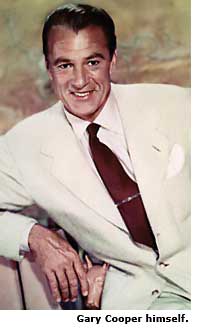
gary cooper himself

When renowned Hollywood actor Gary Cooper built his 'dream house' in the early 1950s -- an ultra-modern, angular concoction featuring stone, glass, and steel -- movie fans smiled and said they knew why.

Cooper had recently portrayed Howard Roark, the egocentric architect at the center of 'The Fountainhead,' a man so passionate about architecture that he made Frank Lloyd Wright -- upon whom the character was clumsily based -- look like a hobbyist.

Roark, a rugged individualist who was guided only by his own vision and considered other architects sell-outs, proclaimed, "I don't work with collectives, I don't consult, I don't cooperate, I don't collaborate." Ayn Rand, the selfishness-is-a-virtue social philosopher who wrote the original novel and the screenplay, called 'The Fountainhead' "a defense of egoism."

To prove his point, in the film's climax, when lesser, weaker men make changes to Roark's masterpiece-in-the-making, a skyscraper, Roark blows it up.

Cooper, the columnists surmised, saw himself as Howard Roark reborn. "The popular interpretation," architectural writer Thomas Hess noted recently, "was that the building was Cooper's actualization of his Howard Roark persona."

The popular interpretation, not surprisingly, was wrong, says Maria Cooper Janis, a painter and documentary filmmaker who lives in New York City. Maria moved into the house as a teenager in 1955 with her parents, Gary and Veronica 'Rocky' Cooper. The house is in Holmby Hills, a neighborhood above Sunset Boulevard that's less known to the general public than the adjacent Beverly Hills -- but more upscale, according to the house's current owner, David Bohnett.
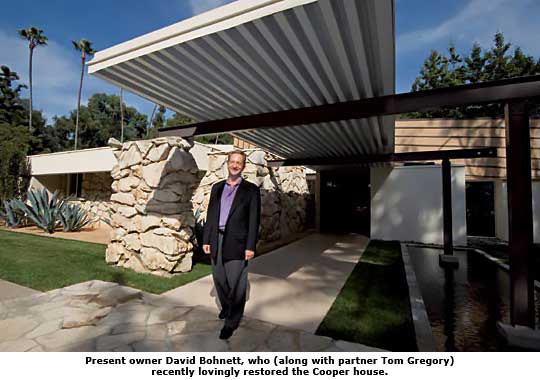
owner of gary cooper house

Her parents, Janis says, had loved modern design for years, and had already built two innovative houses before hiring A. Quincy Jones (1913-1979), of the firm Jones & Emmons, for what would be the Cooper family's final house, where they lived until Gary died of cancer in 1961. "They always liked new, leading-edge things, and always in exquisite taste," Janis says.

"They both knew very much the kind of lifestyle they enjoyed living and they wanted a house to reflect that," she says. "My parents, they loved to break new, unusual ground."

The Cooper house, much as its first owner did, has star power. It's a powerful work by one of California's leading modernist architects, who's known for the thousands of homes he designed for developer Joe Eichler, as well as for custom homes, commercial work, and his work -- cooperating and collaborating with several other architects -- on the Mutual Housing Association's cooperative housing development in Brentwood.
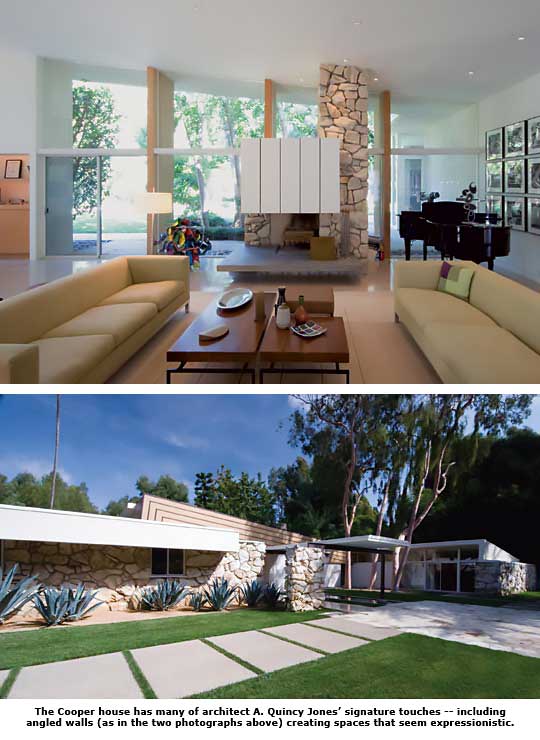
interior and exterior of gary cooper house

Jones' work, especially his early work, is also very Wrightian in its look, while always possessing its own style. "It was so advanced in outline," Cooper once said of the house, "that we sometimes wonder if we're in the year 2000."
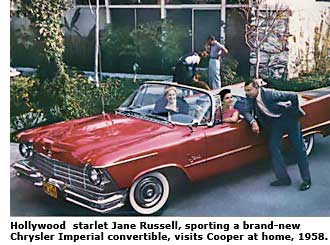
jane russell in a new chrysler

And unlike many mid-century modern homes built in wealthy neighborhoods, which are often demolished by homeowners with Howard Roarkian egos, the Cooper house returned for its second act. Bohnett and his partner, Tom Gregory, have lovingly restored the house and made it a notable part of the Los Angeles charitable events scene.

Bohnett says he was attracted not by its connection to Gary Cooper, but by the architecture itself. "I just thought it was the most beautiful house I had ever seen," he says.

The 6,000-square-foot house has many of Jones' signature touches -- angled walls creating spaces that seem expressionistic; a single-sloped roof rising to a wall of windows; mitered-glass corners; hovering roofs over low, ranch-like wings. But there is also much of the Coopers in it, Janis says.
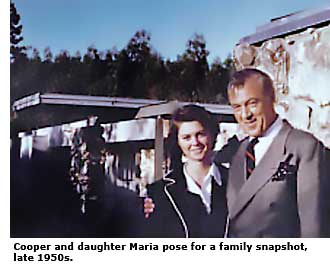
gary cooper and daughter

"The stone in the front was very much my mother and father's idea," she says. "Being from the West, my father loved the sense of nature and the ruggedness of nature."

The Coopers also wanted a stone fireplace and a water feature. Jones gave them a small pool, complete with miniature waterfall, that is half inside the house and half out, flowing beneath a glass wall. The pool was filled with smooth river pebbles, Janis recalls.

"We would collect rocks from the beach and throw them in too," she says. "It was a family thing, bringing nature into the house as much as possible." Each bedroom has its private courtyard.

Janis remembers watching Jones at work, talking intently to her parents before arriving at a design. "They worked closely together," she says. "That was Quincy's way." He became friends with the Coopers, and sometimes socialized with them in years afterwards. Parties at the Cooper house attracted Judy Garland, Frank Sinatra, and Clark Gable, and often involved jam sessions around the piano. But Janis says Jones seemed too busy for much socializing.

quincy jones  architect

"I remember him being very intense about his work," she says.

She also knows one thing: "Quincy Jones was no Howard Roark." Consider what happened when the Coopers, expecting their home to be nearing completion, arrived back in town from a European vacation. They noticed that the walls to the kitchen only went halfway up towards the ceiling. "My mother said, 'When is that going to be closed in?'"

"Oh no," Jones said, "that is never going to be closed in." "Oh no, we can't have that open," Rocky said. "The food smells will come into the house."

Jones, rather than blowing up the house, ran the walls to the ceiling. "He laughed at their inability to read an architectural plan and understand it right there!" Janis says.

It all worked out in the end. "They loved it, absolutely," Janis says of her parents and the house. "He loved the aesthetics of it. My father was an artist before he was an actor. Wherever you looked it was kind of a treat for the eye." Cooper liked the house so much he named his production company Baroda, after the street the house sits on.

gary cooper house in construction

They did have problems with the radiant heat, however. It leaked, causing the floors to buckle.

The Coopers hung paintings by Picasso and the French Impressionists, and Rocky decorated the house eclectically, Janis remembers. There was Chippendale furniture, a 19th century Chinese screen, and modern furnishings by the Hollywood decorator Billy Haines.

The gardens, which were designed by the now-legendary Garret Eckbo, included terraces for Cooper's garden, where he grew tomatoes, potatoes, green vegetables, and corn. "Especially corn," Janis says. "We loved fresh corn." They'd enjoy it while barbecuing alongside their nearby tea house.

Cooper also appreciated the three-car garage, where he enjoyed working on his cars, which ranged from Jaguars to a custom Plymouth with rocket-size tailfins and enough power to move like a Titan rocket. "He was under a car as much as he was in it," Janis says.

gary cooper wife and daughter curbside

In many ways, Cooper was a simple guy. Janis remembers a father who'd use phrases like 'hot ziggity,' or 'by damn!' when he was excited, and would drive the family to Sun Valley while reciting 'The Cremation of Sam McGee,' the famous Robert W. Service poem. But he was Hollywood as well, and an affair with Pat Neill (his co-star in 'The Fountainhead') led to a marital rift that lasted several years, with Cooper out of the country most of the time.

The house, Janis says, "brought mother and father together. Working together on building the house was a very good vehicle, working together on something new."

David Bohnett, who bought the house in 1998, was also attracted by the idea of working on something new. He hired architect Mark Rios of the firm Rios Clementi Hale Studios to upgrade the home's systems and to make some relatively minor changes. A prior owner had done a more substantial restoration, undoing damage wrought by earlier owners.

baroda wall

But Bohnett's transformations of the setting have been profound. Working with Rios, he redid the garden, brought in artist Brad Howe to create 'the Baroda Wall,' 240 feet of retaining wall filled with abstract forms that tell the story of the house, its setting, the clouds that scud by.

interior and pool views

To get more elbow room, Bohnett -- who made his fortune by founding the pioneering community website GeoCities in 1994 ("I knew right from the beginning that this was going to be big," Bohnett later told the 'Wall Street Journal.' "I got an email every time someone would register. There were ten a second at one point.") -- bought two adjoining homes and ripped them down.

One home was an inconsequential thing from the 1970s, Bohnett says. The other was nicer, but had been badly altered. His five-acre lot today has meandering walks, an arroyo, a half-hidden Airstream trailer, and lots of open space.

Maria Cooper Janis, who has become friends with the new owners, approves. "He's made the whole thing into a nature reserve. He's got quite a lot of respect for the character of a place," says Janis, whose husband, Byron Janis, is thea renowned classical pianist.

One of his goals, Bohnett says, was to ensure that the Cooper house remain intact. Any future owner, he says, now has enough acreage to build an immense mansion while leaving the relatively modest home alone. "I think there is plenty of other room to build," he says.

Bohnett, an art collector with pieces by Donald Judd and Ed Ruscha, among others, considers the home to be part of his collection. But he no longer lives there. Instead, he had Rios remodel a rambling Beverly Hills Colonial a short drive away.

"I like a project," Bohnett explains. "This house was a major project -- acquiring the other pieces of property and integrating them together, and creating the paths. Once I was done, I was looking for another project to sink my teeth into. That's the traditional house that I'm reconstructing."

Owner David Bohnett

The Cooper house "provided the opportunity to do a lot of entertaining and a lot of fundraising for the causes that are important to me," says Bohnett, whose David Bohnett Foundation focuses on a range of issues, from "mass transit and non-fossil fuel transportation" and gun control to cybercenters for organizations serving gay and transgendered people. Bohnett has also been a trustee of the Los Angeles County Museum and has served on the board of the Los Angeles Philharmonic.

Moving out has not been a wrenching experience, Bohnett says. "But it would be if I sold it."


Photos: John Eng; courtesy Maria Cooper Janis and the estate of Gary Cooper, A. Quincy Jones Architecture Archive, Ayn Rand Institute, Simon Elliott, 'Town & Country' magazine


'Fountainhead' on film:
a classic or calamity?

fountainhead movie poster

The motion picture of 'The Fountainhead' (1949) proved to be "an architectural (and cinematic) disaster," in the words of no less a critic than Frank Lloyd Wright. For years author Ayn Rand had unsuccessfully pestered Wright to serve as her novel's acknowledged model. He refused to meet with her, though years later she did visit him at his Taliesen West studio-home.

Rand finally proceeded without Wright's help, writing him that she had borrowed not the biographical details of his life but "only the essence of what constitutes a great individualist and a great artist."

Wright did agree to design buildings for the film -- but she balked when he demanded a fee of $250,000.

There is no indication that Rand ever asked famed Los Angeles modernist Richard Neutra to design for the film -- even though Rand was living in one of his greatest buildings, the Josef von Sternberg house, a low-slung, streamlined masterpiece with a curved aluminum wall and a moat. Perhaps it's because Neutra, who had a strong personality but was not as flamboyant as Wright, never wore a cape.

Rand, who hovered over 'The Fountainhead' set to make sure director King Vidor changed nary a word of her script, had proposed Gary Cooper for the role of egocentric architect Howard Roark. Cooper's performance was uncharacteristically wooden -- perhaps befitting the stilted dialogue. "The most asinine and inept movie that has come from Hollywood in years," the 'New York Times' wrote, reflecting critical consensus.

ayn rand director gary cooper and ayn rand and husband

Yet the film retains a strong appeal -- especially to fans of modern architecture, who get to see plenty of it during the film. It appeals also to fans of Gary Cooper's pectorals, for the same reason. Unrepentant Randians (until the recent economic collapse, ex-Federal Reserve chairman Alan Greenspan was one) also enjoy the film -- as do fans of fruity dialogue.

But at the time, most architects did not approve. Some objected to the portrayal of its architect-hero as a criminal. Others bleated because the film suggested that all other architects were sheep.

In fact, by rejecting altruism as a virtue, and arguing that architects should focus on nothing but their own inner vision, Ayn Rand in 'The Fountainhead' contradicted one of the founding ideals of the modern movement -- that a major goal of modern architecture was to improve the lives of ordinary people. That was an ideal that A. Quincy Jones never forgot.


dura-foam solar center
eichler solutions

Top of Page


pixel

The Eichler Network
info@eichlernetwork.com