


key con remodeling fair  dura-foam solar center  nil erdal realtor
Eichler Network CA Modern
ca modernmagazine cover
To Get
CA-Modern
Magazine
Click Here
kitchen contest pick a winner
pixel
HOME | ABOUT | CONTACT | ADVERTISE
abril roofing


transparent pixel
features on
file

JOE EICHLER PROFILE
Eichler's Iron Will, Steadfast Vision, and Unwavering
Integrity Were Vital to His Success as Merchant Builder

From the pages of the Eichler Network newsletter
By Paul Adamson

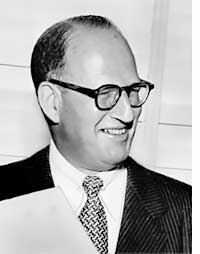
joe eichler 1952

Joseph Eichler was successful at building uniquely modern house designs and unusually progressive residential communities despite tremendous odds. His success was due to his iron will and his courage to hold steadfast to a vision for suburban communities founded on social and artistic ideals singularly suited to their time and place. Eichler was a lifelong political liberal, and he was guided in his actions by an enduring belief in the American potential for continuing social betterment.

His contribution to the merchant builder community was unique. Rare enough in appearance, the entire conceptual basis for Eichler Homes was almost unbelievably idealistic for the notoriously competitive home-building industry. As one of his founding partners, Jim San Jule, has said of Eichler's developments, "Everything about them was different." The homes and communities Eichler built -- modern in both concept and expression, and socially sensitive in their planning -- bore the stamp of Eichler's unwavering ideological integrity and swaggering self confidence.

Born in New York to European Jewish parents, Eichler was raised in a politically liberal family that revered Franklin Roosevelt, and grew to maturity in the culturally diverse community of New York City. His education was pragmatic; a business degree from New York University and a career start on Wall Street helped prepare Joe for a business career. A competitive man by nature and cultivated in the tough-minded atmosphere of America's financial capital, Joe was primed for leadership in business. He would eventually join the highly competitive wholesale food industry, working for his in-laws' family-run poultry concern. The Eichlers moved to the West Coast in 1940, where Joe assumed the position of treasurer for the family business, which was based in San Francisco. By this time the Eichler family included his wife, Lillian, and two sons, Richard and Edward, or Ned. Now 40, Joe was, by all ordinary measures of the day, a highly successful man. Events during the next few years would cause Eichler to start over with an entirely new career.
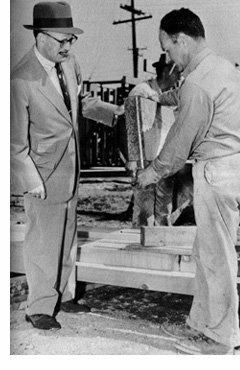
joe eichler on construction site

In 1942, Eichler spotted a rare opportunity for his family, and rented a Frank Lloyd Wright Usonian, known as the Bazett House, in Hillsborough from an Air Force pilot who was stationed overseas. The experience Eichler had living in this house would change his life. Eichler, who had been an admirer of Wright, now gained a deeper appreciation for his architecture. He was intrigued by the Bazett house and delighted in its spatial complexities -- the overlapping of exterior and interior, and the way daylight filtered in from so many directions, changing the mood of each room throughout the day. Three years of living in the Bazett house may very well have loosened Joe Eichler's spirit enough to allow him to feel his own internal stirrings for creative self-expression. So, when a scandal involving the family business forced Eichler to seek a new career, his experience in this house was in large part what inspired him to launch a home-building concern.

When the war ended, Eichler began his new venture, building prefabricated houses on individual lots. Over the next two years, Joe developed the company to the point where he was building small tracts. Meanwhile, no doubt thinking of his family's enjoyment of the Wright house during the war, Joe sought out an architect to design them a new family home. He settled on Robert Anshen, a young architect educated at the University of Pennsylvania, who was beginning a practice of his own after working for the Navy on local projects during the war. Anshen was tremendously energetic and a truly gifted designer who, like many of his generation, could not help but be influenced by the work of Frank Lloyd Wright. No doubt, his appreciation for the American master appealed to Eichler, who had come to admire Wright almost as a hero. Anshen was headstrong and tough-talking, just as Eichler was, and this earned the architect Joe's respect, something he was usually reluctant to bestow on anyone.

It was this respect for Anshen's character which lead Eichler to entrust him in 1949 with the designs for a new subdivision in Sunnyvale. Eichler had been building conventionally designed tract homes since 1946, but despite his success, Anshen sensed that Joe was unsatisfied with his product. Joe's younger son, Ned, who would later join the business, recalls a conversation between Anshen and his father in which the architect criticized his work. "Joe," he asked, "how can someone like you, who loves real architecture, build this crap?" Anshen proposed that Eichler hire him to design a subdivision. Eichler at first dismissed the idea with a scowl, claiming Anshen lacked the discipline to design within the strict budgets required in merchant building. Eventually, however, it was agreed that Anshen would develop three prototypical designs for a 50-unit subdivision in Sunnyvale. That subdivision sold out in two weeks, and the national press hailed their success as a bold, new kind of tract house.

The designs Anshen and Eichler had produced were radical and, to pursue the new direction they implied, would require more-sophisticated salesmanship than Eichler had used so far. Anshen recommended they partner with a friend of his, Jim San Jule, who had a penchant for managing difficult publicity. Anshen introduced Eichler to San Jule, whose background could not have been more different than Eichler's. A union organizer, and former agent with the OSS, the wartime intelligence agency which would become the CIA, San Jule had arrived in San Francisco in 1932, after riding around the country on freight trains, and working at odd jobs to get by. San Jule's obvious toughness and resourcefulness impressed Eichler enormously. Joe Eichler, the tough-talking, cigar-smoking New Yorker, admired San Jule's equally rugged character, and this admiration lead to a close personal friendship.

Toughness and arrogance characterized Eichler's new company, and Eichler began a campaign -- a crusade of sorts -- to develop his new houses around the Bay Area. His confidence in the company's new designs, and his vision of himself as a righteous pioneer, made Eichler an imposing new presence in the merchant-builder scene. His arrogance of purpose, however, would also threaten his success when it came to persuading city officials to permit his radical designs.

On one occasion, when Eichler was required to present a proposed subdivision before the city council of Palo Alto, which even in those days was a very sophisticated group, his zeal got the better of him, and he risked derailing the entire approval process. Representing their close-knit university community, the Palo Alto council was especially circumspect when examining building and land-use proposals within their borders. During one hearing, a dispute arose over a relatively minor issue, and Eichler blew up, giving the council members a terrific blast. Jim San Jule recalls, "He gave this tremendously arrogant, angry speech about the superiority of his designs and the national press they had attracted." Calling the council members disparaging names, he accused them of being ignorant of the benefits he was providing. The next day, San Jule asked Eichler to defer from representing their projects before civic authorities. Explaining that he felt as strongly as Eichler did about their work, San Jule persuaded Eichler that he would be a more diplomatic, although equally determined public spokesman. Eichler grumbled about this criticism, but eventually agreed, and he never again appeared before a city council.

Eichler was equally tough around the office. As one employee recalled, "He always had a frown on his face, grumbling at people." However, regardless of his demeanor, Eichler's tremendous honesty and ethical integrity earned him unusually strong employee loyalty. His stand against racial discrimination and his devotion to modern aesthetics, despite harsh and protracted criticism on both counts, gained him the loyalty of his largely liberal staff, and eventually the respect of his detractors. When his architects came up with the atrium plan, probably the most distinctive and popular design feature of Eichler Homes, the builders objected strenuously, pointing out the complexity of construction and the additional detailing required. But Eichler stayed true to his architects' designs, and eventually the bugs were worked out of the building process. In the end, even those in the production staff who had decried the idea came to respect Eichler's unrelenting stand.

Eichler's success is all the more remarkable, considering the wholly original approach he and his company took to their home-building process. He ruled his company with an unfaltering will and it took tremendous vigilance on everyone's part to ensure the company's success. San Jule, who remained with the company until 1955, remembered the strain was enormous. He claims Eichler and he both neglected their families while working 12 to 14 hours a day every day of the week. Even when Eichler had achieved a smooth, dependable working method, he strove for newer challenges, eventually pioneering his ideas in an urban setting, with townhouses and high rises in San Francisco.

In 1961, Eichler Homes went public, and that changed things for Joe Eichler. He disliked being beholden to the stockholders. Having to put sales goals ahead of his intuitive desire to continually tinker with the designs frustrated Eichler's creative ambitions, and contributed to a brooding dissatisfaction. He hated having any control wrested from him, and resisted the advice of financial experts, including his son, Ned, who pleaded with him to take less risks. Eventually, Eichler's continual quest to pursue progressive ideas may have overwhelmed the company's ability to remain profitable. In 1967, Eichler sold the company for considerably less than it had been worth only a year or two earlier.

Joe Eichler continued to build housing until his death in 1974, although with a series of reincarnations of his original company. However, none of these subsequent efforts matched the earlier projects in their enthusiasm for new design ideas, or in their social aspirations. However, Eichler's work during the period from 1950 until 1967 left a legacy of design integrity, and unprecedented challenges to the political status quo of developer housing, which remain unparalleled in the history of American building.

Joe Eichler was successful at building uniquely modern house designs and unusually progressive residential communities despite tremendous odds. His success was due to his iron will and his courage to hold steadfast to a vision for suburban communities founded on social and artistic ideals singularly suited to their time and place. Eichler was a lifelong political liberal, and he was guided in his actions by an enduring belief in the American potential for continuing social betterment.

His contribution to the merchant builder community was unique -- rare enough in appearance, the entire conceptual basis for Eichler Homes was almost unbelievably idealistic for the notoriously competitive home building industry. As one of his founding partners, Jim San Jule, has said of Eichler's developments, "Everything about them was different." The homes and communities Eichler built -- modern in both concept and expression, and socially sensitive in their planning -- bore the stamp of Eichler's unwavering ideological integrity and swaggering self-confidence.


dura-foam solar center


Top of Page


pixel

The Eichler Network
info@eichlernetwork.com