

Eichler Network CA Modern
ca modernmagazine cover
To Get
CA-Modern
Magazine
Click Here
kitchen contest pick a winner
pixel
HOME | ABOUT | CONTACT | ADVERTISE

transparent pixel
palm springs modern

THE ALEXANDER HOMES
Behind the pioneering Alexanders and their 2,500
modern homes that changed the face of Palm Springs

By Robert Imber

alexander
home palm springs

Southern California's alluring desert and an enticing village called Palm Springs captivated an impressive list of talented architects by the 1920s. Lloyd Wright, son of the master, designed downtown's 1923 Oasis Hotel, a slip-form concrete monument to early California Modernism. In the 1920s and 1930s R.M. Schindler and Richard Neutra had one-of-a-kind desert commissions; and a young Swiss architect, Albert Frey -- fresh from a stint in Paris with Le Corbusier -- was beginning a distinctive career that forever changed the region's design aesthetic.

From the 1940s through the 1970s prolific regional modernists such as William F. Cody, Donald Wexler, and E. Stewart Williams were carving prominent careers with striking custom homes, impressive commercial complexes, hotels and motels, and commanding civic and educational campuses. They and other modernists created an architectural treasury of great consequence and innovation in and around Palm Springs. For all that, the city more or less remained a sleepy seasonal village for affluent snowbirds through the 1940s.

Then, a tail-finned postwar America began gathering under the invigorating desert sun. In rapid tempo, Hollywood's ingénues and elite followed suit, discovered that Palm Springs was the perfect playground to frolic discreetly. Tennis, golf, plush resorts, and swimming pools in every imaginable shape soon surrounded a stylish downtown promenade of tasteful shops, bustling eateries, and swanky cocktail lounges.

A bevy of builders emerged to fill a new need for mass-market housing, spurred by the city's growing year-round population and an increasing demand for vacation homes. Chief among them was the George Alexander Construction Company, headed by the father-son team of George and Robert Alexander, successful builder/developers from Los Angeles. They arrived in 1955 with an able track record of single-family subdivisions in LA. and, more importantly, a keen interest in pioneering architecture.

In the decade that followed, the Alexanders changed the face of Palm Springs with the construction of more than 2,500 homes in the modernist idiom. In 1999, the 'Desert Sun' newspaper quoted an earlier article: "Because of their [the Alexanders'] vision, Palm Springs took a new shape and a new direction in development. They believed that in this luxury community, quality homes could be built to fit the budgets of lower and middle income families...Because of the Alexanders, Palm Springs has not only grown, it has grown in a much more balanced and solid way." In the same article, former Palm Springs mayor Frank Bogert is quoted as saying, "I give George Alexander full credit for doubling the size of this city."

"Designed by Architects, Built by Master Builders for Permanent Value" boasted the Alexanders' early ads. With spacious open plans, beguiling modern conveniences, and an underlying sophistication, their homes appealed to buyers eager to shed the trappings of large, unwieldy houses for a more casual, carefree way of life. In an era of uninspired ranches and mock colonials, the Alexanders' uncomplicated designs of strong form and angles articulated a bold, new residential look.
alexander home in palm springs

Key to the Alexanders' success was their association with a talented young architect, William Krisel, partner in the Los Angeles firm Palmer and Krisel, Inc. Educated at the University of Southern California, Krisel embarked on professional life under the tutelage of California designer Paul Laszlo, worked for a time at Victor Gruen Associates, and eventually retired (while licensed in five states) with a body of residential work in excess of 40,000 units. Krisel still likes to remind us of his understanding that the way to a builder's heart was through his wallet. Through efficient planning, creative use of simple resource, and straightforward construction techniques, he kept costs down without affecting the quality of design.

Exposed roof planks accented adjacent ceiling beams with decorative as well as structural value. Three-quarter walls divided rooms, allowing in an abundance of light while making construction (and associated costs) of a full, framed wall unnecessary. Eliminating molding and trim created a clean, contemporary new look, and at the same time saved time and money.

Repeated use of the same floor plan within a development ensured savings in construction and materials. But, in a brilliant stroke, the architect oriented and embellished each house differently on its site, making Alexander developments look like a collection of individualized custom homes, when in fact most of the house's footprints were identical. Typically in the 1950s, builders replicated popular-selling plans, but the firm of Palmer and Krisel was encouraged to conceive entirely new ideas for the Alexanders. Krisel was involved with every facet of design, planning, engineering, and construction -- from siting and landscape choices to decisions regarding marketing and advertising, interior colors, and incidental trim.

Their first joint project in Palm Springs, the Ocotillo Lodge, opened in 1956. Today, this hotel is a sad and neglected relic of a bygone era, but in its heyday the dazzling structure's sweeping curved dining room was dressed to the nines, resting above the immense keyhole-shaped swimming pool while capturing views of its carefully arranged modern bungalows and the spectacular mountains chiseled in the distance.

The Alexanders' foray into desert tract homes began with Twin Palms Estates, a new neighborhood that established the template for all Alexander houses to follow. Named for the two palm trees included in the front landscaping of each home, Twin Palms sold rapidly and has remained a fashionable address from the outset. Hallmarks were a single-story floor plan with open circulation patterns, and a magical indoor/outdoor feeling enhanced by bathroom skylights and a tiny interior atrium off the master bedroom. A small but distinctive entrance hall faced a central hub of side-to-side bathrooms that divides public areas from private zones.

alexander home in palm Srpings

All but a handful of the three-bedroom houses were identical in plan, with a 16-foot by 32-foot in-ground swimming pool in the backyard. But the similarity ended there. On concrete slabs, built of post-and-beam construction with standard-sized lumber, the 40-foot by 40-foot stucco houses were intermittently rotated on their lots and offered a variety of rooflines. When one pays particular attention to a series of front elevations on almost any street of Alexanders, a pattern will emerge. From left to right, or right to left, the pattern is parking, breezeway, windows, and wall. Then, while rotating one of those houses clockwise 90 degrees, one can recognize that the houses with street-facing front doors are actually the same as those with a side-entry front door in the breezeway. The move was ingenious and innovative, efficient and cost saving.

Buyers could choose between flat roofs with wide vertical wood or stucco fascia panels attached downward as sunscreens; flat roofs capping thin clerestory windows that shielded bedrooms from the street but brought in sunlight and mountain glimpse-views; center- or side-vaulted roofs angled above soaring gabled glass walls; and a wild assortment of 'butterfly' roof designs that connected the house to its carport and the center breezeway entrance court. Whimsical butterfly roofs became customary in contemporary residential design, though they were rarely executed as gracefully as on the Alexanders.

Streetside, facades stretched almost the full extent of the 100-foot wide lots. Concrete block or extended stucco walls connecting house and carport were intended to add length to the front of the house for a more imposing appearance. Idiosyncratic decorative elements made use of wood, decorative concrete block, patterned brick, two-tone paint, rock, ironwork, spun fiberglass panels, and other materials. Front landscaping sometimes included gently sloped berms crowned with palm trees, a Krisel idea that was as much a cost-saving measure as smart landscape design (Why haul away dirt and light debris when it could be buried under a mound and attractively planted?).

In the very first Alexanders forced-air heating and air-conditioning was included, but insulation was not. Perhaps with his vigilant economy-of-design philosophy, Krisel figured that in a desert climate clothing in the bedroom closet wall would insulate temperature changes and further provide an acoustical barrier between rooms. Practical kitchen and bathroom cabinets were fabricated on-site. They were wall-hung and freestanding wooden units with sliding pegboard or Masonite doors that made hinges and hardware unnecessary. Resting on thin, u-shaped steel legs for a floating, furniture-like quality, original cabinetry is rarely found intact these days. More often than not, the prized freestanding kitchen island has served as a poolside bar for a few decades.

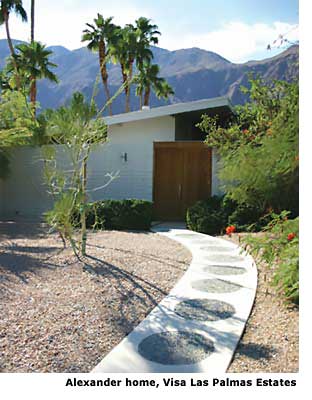
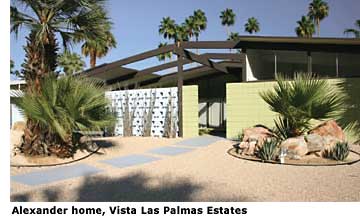
Twin Palms was followed by larger homes in developments such as Mountain View Estates, Golden Vista Estates, and Vista Las Palmas Estates, nearer to the center of town and adjacent to an established neighborhood of substantial homes and gated mini-estates. A promotional model home was built in the center of the city on the grounds of the famous Desert Inn.

These later houses incorporated the fundamentals from previous Alexanders but in an enlarged version. More models were added, including a center atrium plan, coincidentally in parallel to homes Joe Eichler was introducing in Northern California. While there are countless similarities in the groundbreaking housing concepts advanced by both Eichler and the Alexanders, historic records don't mention that they were familiar with each other's work. But each in their own right widely influenced housing throughout the United States in ways unlike anyone else.

Deluxe amenities included elaborate fireplaces, deep roof overhangs, built-in kitchen appliances, Shoji screen room dividers, terrazzo-like vinyl flooring inlaid with bronze trim, acoustic ceiling panels, sunken tubs and showers, and mirrored walls. And these Alexanders were insulated! Woven redwood fencing neatly defined property lines, and two trees (though not always palm trees) remained the mainstay of front landscaping.

alexander home, racquet estates

Citywide the collection of Alexanders ranges from 1,225 square feet in Racquet Club Road Estates at the far north end of town to over 2,500 square feet, and were originally priced from $16,950 to the low $50,000s. But in the 1970s Palm Springs entered a tremendous economic decline and exodus of population, so much of the architecture remained untouched for decades. More recently, an influx of newcomers and the increasing boomer market in search of modernist homes have been perhaps the primary forces in the growing revitalization of Palm Springs. Today, a refurbished Alexander sells from $400,000 to well over one-million dollars.

In its decade-plus of building in Palm Springs, the Alexander Company and Palmer and Krisel garnered frequent national attention, sharing innumerable awards for excellence in planning, design, and construction. Bill Krisel's lavish spec house for the Alexanders, partially intended for publicity purposes, was so treasured by Helene Alexander that she insisted they move into it themselves. Hovering over an inclined cul-de-sac site and balanced on winged walls of local stone, the 'House of Tomorrow' was featured along with Bob and Helene Alexander (and daughter Jill) in a September 1962 Look magazine article, 'The Way Out Life' that boasted "at Palm Springs, dreams of modern luxury come true."

The Alexander family philanthropy was legion as was their eminent standing in Palm Springs' social set in an era of martini-toting Ratpackers and elite snowbirds. Their house is a boomerang-shaped assemblage of circular themes and hexagonal levels that takes advantage of sloping topography to command exhilarating views. A one-of-a-kind architectural achievement built at a cost of $300,000 in a day when $100,000 was extravagant, much of the House of Tomorrow's current fame stems from it's year in service as Elvis and Priscilla Presley's honeymoon hideaway.

Sadly, the Alexanders never knew the lasting impact of their contribution to the community and to housing in America. On Sunday, November 14, 1965, at the peak of their lives and careers, George and Bob Alexander were killed, along with wives Mildred ('Jimmie') and Helene, in a foul-weather private plane crash that devastated the community and their immense circle of friends and associates.

Postwar technology, inventive new materials, the needs of a more sophisticated lifestyle, and an underlying informality of the Alexanders' houses influenced tract homes in communities well beyond Southern California. Along with Eichler's developments to the north, the Alexanders' Palm Springs houses were instrumental in shaping a new way of living and of looking at American residential mass-market design.

robert imber

Endeavoring to heed those lessons and protect from the sameness brought by popular crass development, preservationists today, along with countless residents and visitors. keep a watchful eye over Palm Springs' valuable architectural repository. As striking as when they were new, Alexander neighborhoods throughout Palm Springs are once again fashionable enclaves, popular among first-time home buyers, retiring baby boomers, and architecture devotees from near and far.

Active in the preservation of mid-century modern architecture, contributing writer Robert Imber conducts regular architectural tours and lectures on Palm Springs modern architecture through his company, PS Modern Tours (760-318-6118). He is also executive producer of 'Visions of Utopia,' the first full-length feature film on Palm Springs modern, premiering February 2006 at the Palm Springs Art Museum.

Photos: Adriene Biondo and John Eng, Barry Sturgill (Imber pic)


See other Palm Springs Stories


Top of Page


pixel

The Eichler Network
info@eichlernetwork.com