


key con remodeling fair  dura-foam solar center  nil erdal realtor
Eichler Network CA Modern
ca modernmagazine cover
To Get
CA-Modern
Magazine
Click Here
kitchen contest pick a winner
pixel
HOME | ABOUT | CONTACT | ADVERTISE
abril roofing


transparent pixel
eichler modern

IMAGE THAT MOVED EICHLER
Touching image of inspiration that stirred Eichler's
soul -- two boys, two races, one poignant photograph

From the pages of the Eichler Network newsletter
By Marty Arbunich

The picture was vividly clear: two young boys -- one black, the other Asian-Caucasian -- their arms around each other, strolling home from school to their Eichler neighborhood in Lucas Valley -- in perfect harmony, without a care in the world.

That was the image, alright. It was this photograph, according to legend, that moved builder Joe Eichler in a profound way and, by his own admission, literally provided the sense of purpose Eichler needed to rise each day and pour the next slab of concrete, the other foundation of his life's work.

After scores of interviews over the years covering the origins of the Eichler homes, we had become intimately aware of that photograph, even haunted by references to it; but had never actually laid eyes on it. Yet our wondering persisted: how could such a simple, unassuming image of two small children consume a grown man's soul?
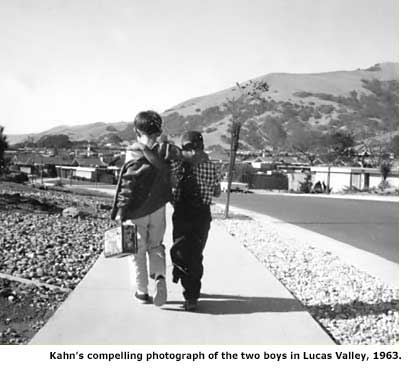
two boys

After a while pieces of the puzzle began to come together. Each new anecdote, it seemed, led to another. Eventually an internet search cleared a path to the family of Albert E. Kahn -- photographer, author, and nephew of Albert Kahn the modernist industrial architect -- who died of a heart attack while driving his car at age 67 in 1979.

"That photograph was not accidental," Brian Kahn said firmly, recalling his late father Albert, a self-proclaimed "radical in the tradition of Jack London" and outspoken critic of the government in the 1950s McCarthy era. "The two children in the photo reflected my father's view of the only type of society worthy of humanity. It is a statement about an alternative world, one my father believed would come." It also was no accident that Joe Eichler and Albert Kahn had crossed paths. They apparently had much in common. "I have a vague recollection that there was more to it than business," offered Brian Kahn. "I remember my dad telling me about Eichler -- his respect for what they were trying to do." Presumably Joe Eichler initially had become aware of Albert Kahn the book author, who had become well known in the 1940s for his anti-fascist best-selling exposés. After the war, Kahn continued to write and publish prolifically, but turned his attentions to battling America's new "cold war" politics, which for Kahn conflicted with the Franklin Roosevelt policies he personally had supported. Because of his outspoken criticism of U.S. foreign and domestic policy, Kahn became blacklisted in the 1950s, appeared several times before committees investigating his alleged un-American activities, and as reported in his obituary, his passport was revoked, phone tapped, mail opened, and his movements closely monitored by the FBI.
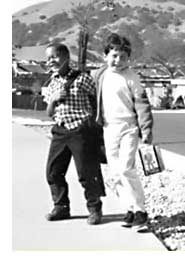
two boys

As a tenacious critic of government deceptions, Kahn refused to give in. "As far as I was concerned, I was acting in the American tradition of Thomas Jefferson and Thomas Paine and the framers of the constitution," Kahn said in an interview shortly before his death. "The idea of any government telling me that I owe unequivocal allegiance to it is the most repugnant thing on earth." In 1955, Kahn struck back when he self-published "False Witness," which exposed the confessions of an FBI informer who, it was alleged, was a paid government witness who delivered perjurous testimony in the midst of blacklisting operations.

All of this turmoil, however, did have an impact on Kahn's livelihood. When he began to experience difficulty finding a willing publisher to issue his books, he turned to photography, out of necessity, to support his family. "My father had a natural sense of composition, and also a special affinity for children," remembered Brian Kahn. "His politics were socialist, and he felt deeply that all children, as the hope of humanity, deserved full and equal opportunity."

Kahn's beliefs also included a deep appreciation of racial equality, something Joe Eichler adamantly pursued in his company policy. "Joe Eichler was blunt and straightforward about his feelings on integration," asserted Catherine Munson, Eichler Homes' first female salesperson and long-time staffer. "Remember, Joe was a man of few words -- so there were no 'pep rallies' at the staff meetings. It was clearly understood by everyone in the company that the integration policy was overt company policy." These grounds for mutual appreciation set the stage for Kahn's meeting with Eichler. In 1963, when Kahn captured the two boys on film, he and his family were living in Glen Ellen, north of Lucas Valley. According to Carolyn Caddes, a Palo Alto Eichler owner who, in the early 1970s, was befriended by both Joe Eichler and Albert Kahn, when Eichler saw Kahn's photograph for the first time "he told Kahn that he was overjoyed." "Mr. Kahn said to me," Caddes continued, "'I don't mean to be boasting, but how can I forget what [Eichler] said: 'That picture catches within [me] one form -- it sums up -- what I believe in and what I'm working for in life.'"

albert kahn

It should come as no surprise that a large, framed copy of Kahn's photograph became the centerpiece of Eichler's Palo Alto office, even taking precedence over his two autographed pictures taken alongside President John Kennedy and Vice-President Hubert Humphrey. In the mid-1960s, when Eichler moved company offices to San Francisco, and even years later to Burlingame, Kahn's image stayed close and prominent.

One Christmas, Eichler featured the photograph on the face of a holiday card, which he mailed to every congressman and senator. "You know, the only one who acknowledged," Eichler told Carolyn Caddes years later, "was Senator Eugene McCarthy's wife, and she sent me a very nice note."

While marketing the Geneva Terrace development in San Francisco during the early 1960s, Eichler emblazoned Kahn's photograph on billboards near his Visitacion Valley townhouse development, and even incorporated it in display ads in San Francisco's major newspapers. "Back then we were looking for a community that was forward-thinking, liberal, and integated," recalled Charlene Avery, whose family eventually bought one of the Terrace townhouses. "We loved Eichler's belief of integrated neighborhoods and wanted to show the world, and our parents, that it could work. A flyer with the two children was one of the selling tools that worked. It tugged at our hearts."

In December 1965, at the formal ceremony for the twin high-rise Geneva Towers project in San Francisco, both Hubert Humphrey and California Governor Edmund Brown participated. With a framed photograph of Kahn's image of the boys in hand, Eichler reached out to the vice president and, according to the program's transcripts, gestured: "May I hand you this picture, as I think it will be of particular interest to you as one of the early-and foremost leaders in the battle for equal opportunity for all Americans."

"While I consider this building a great accomplishment," Eichler continued, " the spirit expressed in this picture means a great deal more to me since it is a most eloquent expression of the philosophy of my organization, Eichler Homes."

After much searching, we eventually uncovered a copy of Albert Kahn's distinguished photograph. Finding the final piece of the puzzle was most satisfying.

children playing

All photos courtesy Albert E. Kahn family.


See other Eichler Modern Stories


dura-foam solar center


Top of Page


pixel

The Eichler Network
info@eichlernetwork.com